Bay Area Market Analysis
San Francisco List Prices Miss by 25%. Here's What to Use Instead

Reviewed by:

Head Agent, California · CalDRE #01997822
Among San Francisco houses sold in 2026, the median list price was $1,598,000 and the median sale price was $2,103,000. The typical house sold for about $425,000 more than its list price.
TurboHome Market Analysis · San Francisco · Published November 12, 2026
The short answer: in San Francisco, the list price has stopped working as an estimate of value. In 2026, it missed the final sale price of the typical house by a median 25.5%. A crude estimate built from the ZIP code’s median price per square foot missed by 13.5%. If you’re pricing an offer in SF, start from comps. In Santa Clara and Contra Costa counties, the list price still works.
This fall’s headlines tell the same story. A Presidio Terrace house at 2 Sixth Avenue listed at $7,999,000 in September and sold for $15 million in October, 87.5% over list (New York Post, The Real Deal). In September, San Francisco homes sold for an average of 131% of list price, the highest month of the year, The Real Deal reported. So what is an SF list price still good for?
List price or price per square foot: which guess is closer?
We ran a simple test on San Francisco single-family sales from 2020 through November 10, 2026. For each sale, we compared two guesses with the final sale price:
- The original list price.
- A ZIP-code comp: the home’s square footage times the median price per square foot for houses in the same ZIP code and size group.
Then we took the median miss in either direction. Lower is better.
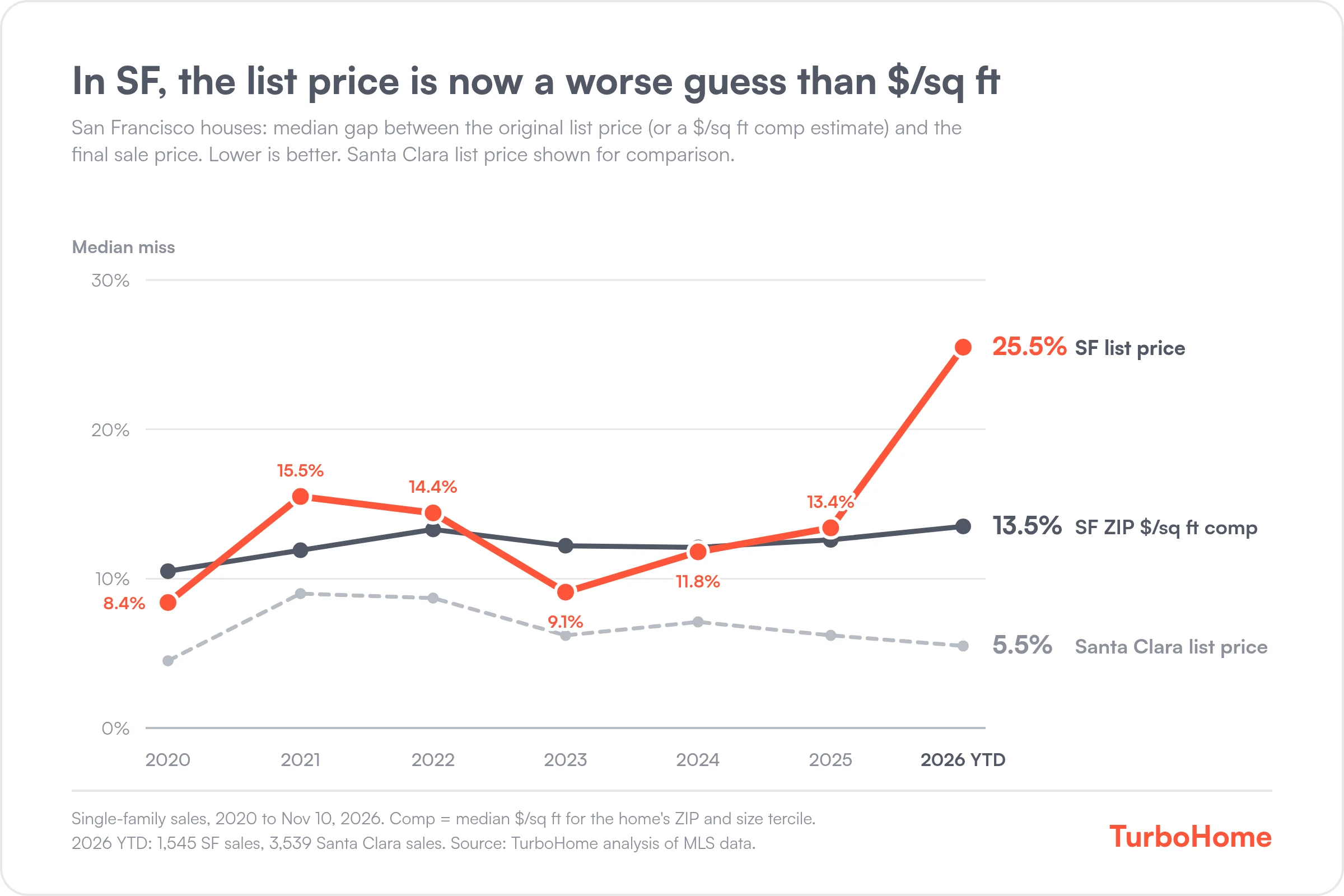
In 2026, the list price missed the final price by a median 25.5%. The comp missed by 13.5%. A guess that knows nothing about the house except its ZIP code and size beat the number the seller put on the listing.
| Year | SF list | SF comp | Santa Clara list | SF sales | Santa Clara sales |
|---|---|---|---|---|---|
| 2020 | 8.4% | 10.5% | 4.5% | 1,724 | 8,529 |
| 2021 | 15.5% | 11.9% | 9.0% | 2,220 | 11,251 |
| 2022 | 14.4% | 13.3% | 8.7% | 1,724 | 8,263 |
| 2023 | 9.1% | 12.2% | 6.2% | 1,389 | 5,935 |
| 2024 | 11.8% | 12.1% | 7.1% | 1,750 | 6,175 |
| 2025 | 13.4% | 12.6% | 6.2% | 1,749 | 4,108 |
| 2026 YTD | 25.5% | 13.5% | 5.5% | 1,545 | 3,539 |
Each figure is the median miss between that guess and the final sale price for single-family homes. “SF comp” is the ZIP price-per-square-foot estimate. Sales are the homes included in each year’s test.
How San Francisco list prices stopped meaning anything
In 2020, the list price was the better guess. It missed by 8.4%, against 10.5% for the comp. In 2021, the list price miss jumped to 15.5%, worse than the comp’s 11.9%. It fell back to 9.1% in 2023 and ran about even with the comp in 2024 and 2025. In 2026, it nearly doubled, to 25.5%. The comp barely moved, from 12.6% to 13.5%.
The overbids explain the jump. In our 2026 data, 91.5% of SF houses sold at or above list price, and 16.1% sold 50% or more over. Outside data says the same. Compass reported that nearly 92% of San Francisco single-family homes sold above list in September, with the average sale nearly 30% over list, up from 13% a year earlier (San Francisco Chronicle). The top end is moving too: sales above $5 million rose 109% from a year earlier, according to Compass data reported by the San Francisco Standard.
Part of it is strategy. The Chronicle reported sellers listing about a third below market value, auction-style. Part of it is supply: only about 240 houses were on the market at the end of September. Our teaser list price analysis found the same thing at the listing stage. Charm-priced SF homes were listed about 15% below their ZIP’s typical price per square foot.
Why adding 25% to the list price doesn’t fix it
If SF houses sell about 25% over list, why not add 25% and call it a day? We tested that too. Marking up every 2026 list price by the typical overbid still missed the final price by a median 11.9%. That’s roughly the comp’s error, and you still know nothing about the house.
The problem isn’t the size of the average overbid. It’s the spread. Some houses are listed near value and close a few points over. Others are listed far below and close 50% or more over, like the 16.1% we found. A flat markup can’t tell them apart. A comp can’t fully either, but it starts from what nearby houses sold for, not from a seller’s pricing strategy.
Outside San Francisco, the list price still works
San Francisco is the exception, not the Bay Area rule. In Santa Clara County, the 2026 list price missed the final price by a median 5.5%, about half the comp’s 10.6% miss there. It has gotten more accurate two years in a row.
The market there is softer. Compass reported 15% more active single-family listings in Santa Clara County in September than a year earlier, 49% more price cuts and a 4% drop in the median price (WRE News). In Contra Costa County, the list price missed by a median 3.6%.
In markets like these, the list price is close to a valuation, and offers near list are normal. See how much over asking homes sell for in San Jose for the South Bay picture.
What this means for you
If you’re buying
- Search below your budget. Look at houses listed about 20% under your top number. In 2026, 91.5% of SF houses sold at or above list, so a house listed at your limit is unlikely to sell for less.
- Build the offer from comps. Pull the last 90 days of sales in the same ZIP, find the median price per square foot for houses of similar size, multiply by the home’s square footage, then adjust for condition, layout, parking and lot. Our San Francisco price per square foot guide is a starting point.
- Compare in dollars per square foot, not percent over list. A 30% overbid on a teaser price can still be a market-rate purchase. See how much over asking homes sell for in San Francisco for the city’s full range.
- Watch the calendar. In our 15-day cliff analysis, SF homes held 123% to 124% of original list price from day 4 through day 14, then dropped to 110.2% on days 15 to 21. A house still for sale after two weeks is a different negotiation.
With your own agent on your side, a Bay Area buyer rebate can also return part of the commission to you at closing.
If you’re selling
- Decide what your list price is for. A list price can be a valuation, the number you expect to get, or a marketing price set to draw a crowd. Either can work. Pick one on purpose and tell your agent which.
- A marketing price needs real demand. Underpricing pays only when enough buyers show up. In our teaser pricing analysis, charm-priced homes in San Francisco closed lower against their ZIP benchmark than round-number homes.
- Know your comp number before you list. Buyers with good agents will price your home from comps. You should know that number first.
If you’re investing or analyzing a market
Sale-to-list ratio is a weak measure of San Francisco demand right now. A 125% ratio says as much about how homes were listed as about what they’re worth. To compare SF with the rest of the Bay Area, use closed price per square foot. For local trends, see our housing market guides for San Francisco, San Mateo and San Jose.
For more San Francisco data, see our analysis of San Francisco condo vs. house prices, days on market in San Francisco and how San Francisco realtor fees work.
Methodology notes
- Source: TurboHome analysis of MLS closed-sale records.
- Geography: San Francisco County for the main test. Santa Clara and Contra Costa counties for comparison.
- Sample: Single-family home sales from 2020 through November 10, 2026. In 2026, the test covered 1,545 San Francisco sales and 3,539 Santa Clara sales.
- List price miss: The gap between the original list price and the final sale price, in either direction, as a percent. Figures are medians.
- ZIP comp: The home’s living area times the median price per square foot of single-family sales in the same ZIP code and size tercile (the ZIP’s houses split into thirds by size).
- Marked-up list price: Each 2026 San Francisco list price raised by the typical 2026 overbid, then compared with the final sale price.
- Median prices: The $1,598,000 median list price and $2,103,000 median sale price cover 2026 San Francisco single-family sales.
- MLS attribution: Data in this report is derived from MLS closed-sale records and is provided for informational purposes only. It has not been independently verified by the Multiple Listing Service and may differ from figures published by MLS associations due to differing cutoff dates, cleaning rules, or geographic groupings.
Sources & further reading
- 9 in 10 S.F. homes are now selling for more than asking — sometimes much more (San Francisco Chronicle, October 26, 2026): Compass data on September overbids, pricing strategy and inventory.
- 92% of San Francisco Houses Sold Above Asking in September (WRE News, October 26, 2026): Compass figures for San Francisco, San Mateo and Santa Clara counties.
- Can Anyone Price Right in San Francisco’s Novel Market? (The Real Deal, October 18, 2026): how SF agents are setting list prices, and September’s 131% average.
- The Real Deal, October 9, 2026 and New York Post, October 8, 2026: the 2 Sixth Avenue sale.
- San Francisco Standard, October 25, 2026: Compass data on sales above $5 million.
These third-party sources use their own methods and reporting windows and may not match TurboHome’s figures exactly. They are included as context, not as the underlying data for this report.
Frequently asked questions
How much over asking should I offer in San Francisco?
Don’t start from the list price. In TurboHome’s analysis of 2026 San Francisco single-family sales, the original list price missed the final sale price by a median 25.5%, and a list price marked up by the typical overbid still missed by 11.9%. Build the offer from recent sales instead: the median price per square foot for similar-size houses in the same ZIP code over the last 90 days, times the home’s square footage, adjusted for condition, layout, parking and lot.
What is the sale-to-list ratio in San Francisco?
Well above 100% for houses. In TurboHome’s 2026 data through November 10, 91.5% of San Francisco single-family homes sold at or above their original list price, and 16.1% sold 50% or more over. Compass reported that nearly 92% of SF single-family homes sold above list in September 2026, and The Real Deal reported that SF homes sold for an average of 131% of list price that month.
Why do San Francisco homes sell so far over list price?
Many sellers price low on purpose to draw multiple offers, and there are few houses to choose from. The San Francisco Chronicle, citing Compass, reported in October 2026 that sellers were pricing about a third below market value, auction-style, and that only about 240 houses were on the market at the end of September. When the list price is a marketing number, the bidding sets the final price.
How do I estimate a San Francisco home’s value from price per square foot?
Find recent sales of similar-size houses in the same ZIP code, take the median price per square foot and multiply it by the home’s living area. In TurboHome’s test, that simple comp missed the final sale price of 2026 SF single-family homes by a median 13.5%, about half the list price’s 25.5% miss. Treat it as a starting point, then adjust for condition, layout, parking and lot.
Does the list price still work outside San Francisco?
Mostly, yes. In TurboHome’s 2026 data, the Santa Clara County list price missed the final sale price by a median 5.5%, about half the miss of a ZIP price-per-square-foot comp there (10.6%). In Contra Costa County, the list price missed by a median 3.6%.
Price the house, not the list price
When the list price is noise, the comp work is the job. TurboHome agents build every offer from price-per-square-foot comps and our own MLS data, and our flat-fee model means you keep thousands back at closing.
About the Author
Lucas Beard
Lucas Beard is COO of TurboHome and holds California DRE license 02417843. His guides reflect TurboHome's buyer-side experience and link to primary sources for regulatory, lender, market, and competitor claims.
View Lucas on LinkedInAbout Kevin Kretzmer
Head Agent, California
Kevin Kretzmer leads TurboHome's California agent team and reviews California and national buyer guidance for practical brokerage accuracy.
View Kevin's profile