San Francisco Market Analysis
San Francisco Condo vs. House in 2026: The Price-per-Square-Foot Math Just Reversed

Reviewed by:

Head Agent, California · CalDRE #01997822
In 2020, a San Francisco condo sold for $1,083 a square foot and a house for $995. In 2026 so far, it is $1,125 for the condo and $1,201 for the house. The most expensive square footage in the city is no longer in the glass towers.
TurboHome Market Analysis · San Francisco · Published October 30, 2026
The takeaway up front: in early 2020, a square foot of SF house sold for 11% less than a square foot of condo. In October 2026, it sold for 13% more. The San Francisco boom is a house boom.
The flip, in one chart
We pulled every San Francisco condo and single-family MLS closed sale since January 2020 and tracked the median price per square foot each quarter.
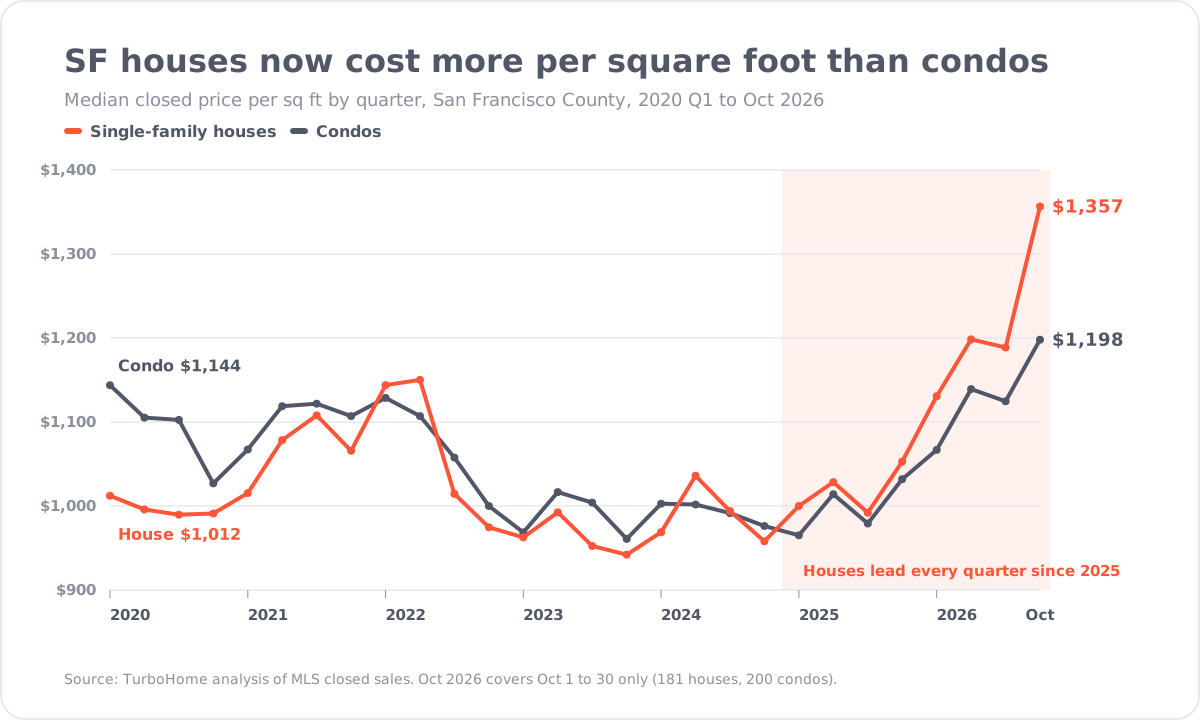
From 2020 through 2024, condos cost more per square foot than houses in 16 of 20 quarters. Since the start of 2025, houses have led in every quarter. The gap was 1% to 4% through 2025, widened to 5% to 6% in each full quarter of 2026, and jumped to 13% in October.
| Period | House median $/sq ft | Condo median $/sq ft | House premium vs. condo |
|---|---|---|---|
| 2020 Q1 | $1,012 | $1,144 | −11.5% |
| 2022 Q2 | $1,150 | $1,107 | +3.9% |
| 2024 Q4 | $958 | $976 | −1.9% |
| 2025 Q1 | $1,000 | $965 | +3.6% |
| 2026 Q1 | $1,131 | $1,067 | +6.0% |
| 2026 Q2 | $1,198 | $1,139 | +5.2% |
| 2026 Q3 | $1,189 | $1,125 | +5.7% |
| October 2026 | $1,357 | $1,198 | +13.2% |
Over the full period, the median house rose 21% per square foot, from $995 in 2020 to $1,201 in 2026 through October 30. Condos rose 4%, from $1,083 to $1,125.
Why this is so strange
San Francisco houses are much bigger than condos. The median house that sold in our data had 1,860 square feet. The median condo had 1,150. Houses are 62% larger.
Bigger homes almost always sell for less per square foot. The kitchen, bathrooms, and land carry much of a home’s value, and every extra bedroom adds less than the last one. That is why a 3,000-square-foot house usually costs more in total than a 1,500-square-foot one, but less per foot.
So for houses to cost more per foot than condos, buyers have to be paying well past that size discount. For most of the last six years, the normal rule held, and condos looked expensive per foot because of new construction, amenities, and views. In 2026, the rule broke.
Where the money is going: bidding wars on houses
The difference is overbidding, and it is concentrated almost entirely in houses.
- 59% of SF houses closed at 20% or more over asking in 2026 through October 30. For condos, it was 17%.
- In 2020, those numbers were 18% for houses and 2% for condos.
- The median house closed at 124.9% of list price in 2026. The median condo closed at 101.7%.
In plain terms, the typical house buyer this year paid about a quarter more than the asking price. The typical condo buyer paid close to list.
Several forces point the same direction. Supply of houses is thin: The Front Steps reported 154 single-family listings in San Francisco in July, against 353 condo listings. New wealth from the AI boom is chasing the limited supply of homes with yards and their own front doors. And the metro-wide numbers are strong: Redfin data cited in a Bay Area market update put the San Francisco metro median up 18% year over year, the largest gain among the 50 biggest metros, while San Jose fell about 5%.
The headline story is that “SF is hot.” Our data says the heat is mostly in one product type. Condos are rising, but slowly. Houses are where the bidding wars are.
Are condos next?
There are early signs that condo demand is turning.
- Condos that closed in October 2026 posted a 107.2% median sale-to-list ratio, the highest quarterly reading in our data since 2020.
- Condos are selling faster. The median condo spent 15 days on market in 2026, compared with 31 days in 2020.
There are two ways this can go.
Scenario 1: condos catch up. If October’s 107% sale-to-list holds, buyers priced out of houses are moving into condos, and the per-foot discount should start to close. In that case, condos bought now are the catch-up trade.
Scenario 2: the gap is structural. If October fades, the gap may reflect a lasting shift in what households want since the pandemic: more space, outdoor areas, and no shared walls. In that case, the condo discount persists.
One month of closings is a small sample (about 200 condo sales), so treat October as a signal to watch, not a trend.
What this means if you’re buying or selling in San Francisco
Buyers: the condo is now the relative value
If you want the most space per dollar, the condo is now the better deal per foot. A $1.5M budget will often lose a house bidding war at 25% over asking, but it can compete for a condo near list price. Condo buyers should still underwrite HOA dues, special assessments, and building reserves, because those costs change the real price of ownership.
Buyers: write offers by property type
The offer strategy that wins a house is different from the one that wins a condo. For houses, the list price is often a starting point well below where the home will close. Look at recent sales nearby, not the asking price. For condos, list price is still a reasonable anchor in most buildings, and there is more room for inspection and financing protections.
Sellers: underpricing works for houses, not condos
House sellers are pricing low on purpose and collecting overbids of 20% or more. Condo sellers cannot copy that playbook. List a condo 20% under value and you will mostly get a sale near that lower list price. Pricing strategy has to match the property type.
Everyone: overbids inflate percentage commissions
On a $2.1M sale of a house that closed 25% over list, a 2.5% buy-side commission comes to $52,500. About $10,500 of that exists only because of the overbid. A percentage commission grows with every bid. A flat fee does not.
For more San Francisco data, see how long it takes to close in San Francisco and the San Francisco housing market page.
Methodology notes
- Source: TurboHome analysis of MLS closed sales in San Francisco County.
- Property types: Condominiums and single-family residences only. Tenancy-in-common units, co-ops, and townhouses are excluded.
- Date range: Closings from January 1, 2020, to October 30, 2026. “2026” figures cover January 1 to October 30, 2026.
- Metrics: Medians throughout. Price per square foot is close price divided by MLS living area. Sale-to-list uses the final list price, so it can overstate overbids where the price was cut before sale (rare for SF houses in 2026).
- Cleaning: Sales with a price per square foot below $200 or above $5,000 were removed to drop bad square-footage records.
- Sample sizes: 2020 had 1,692 house and 1,911 condo sales. 2026 through October 30 had 1,531 house and 1,759 condo sales. Quarters range from 260 to 924 sales per property type, except October 2026 (181 houses, 200 condos).
- Caveats: The October 2026 figure is one month and a small sample; the full-quarter 2026 premiums of 5% to 6% are the conservative read. MLS living area for houses often excludes unpermitted or below-grade space, which can raise house price per square foot, but that bias existed in 2020 too and does not explain the change. Neighborhood and building mix varies by quarter. Off-MLS sales are excluded.
- MLS attribution: Data in this report is derived from MLS closed-sale records and is provided for informational purposes only. It has not been independently verified by the Multiple Listing Service and may differ from figures published by MLS associations due to differing cutoff dates, cleaning rules, or geographic groupings.
Sources & further reading
- Bay Area Housing Market Update: Week of October 23, 2026 (David Park Homes): San Francisco vs. Santa Clara sale-to-list, and Redfin metro price changes.
- Bay Area housing market squeezes first-time buyers while luxury homes boom (NBC Bay Area, October 6, 2026)
- SF Real Estate Update, August 2026 (The Front Steps): July single-family and condo overbids and listing counts.
- Bay Area condo prices fall, except in tony San Francisco areas (The Real Deal, May 4, 2026)
These third-party sources use their own methods and reporting windows and may not match TurboHome’s figures exactly. They are included as context, not as the underlying data for this report.
Frequently asked questions
Is a condo or a house more expensive per square foot in San Francisco?
As of 2026, houses. The median San Francisco single-family home sold for $1,201 per square foot in 2026 through October 30, compared with $1,125 for condos. In October 2026 alone, houses sold for 13% more per square foot than condos. In 2020, the reverse was true: condos cost more per foot.
How much over asking do San Francisco houses sell for in 2026?
The median San Francisco house closed at 124.9% of list price in 2026 through October 30, and 59% of houses closed at 20% or more over asking. For condos, the median was 101.7% of list, and 17% closed 20% or more over asking.
Are San Francisco condos a better value than houses right now?
On a price-per-square-foot basis, condos are the relative value in 2026, and condo bidding is far less intense. Condo buyers should still review HOA dues, special assessments, and building reserves, which can change the real cost of ownership.
Are San Francisco condo prices starting to catch up?
There are early signs. Condos that closed in October 2026 had a median sale-to-list ratio of 107.2%, the highest quarterly reading in TurboHome’s data since 2020, but that reading covers one month and about 200 sales.
Talk to a TurboHome agent about condo vs. house strategy
When houses close 25% over asking, a percentage commission grows with every overbid. TurboHome charges a flat fee, so your agent cost stays the same whether you win at list or at 130%. Talk to a TurboHome agent about condo vs. house strategy in your neighborhood.
About the Author
Lucas Beard
Lucas Beard is COO of TurboHome and holds California DRE license 02417843. His guides reflect TurboHome's buyer-side experience and link to primary sources for regulatory, lender, market, and competitor claims.
View Lucas on LinkedInAbout Kevin Kretzmer
Head Agent, California
Kevin Kretzmer leads TurboHome's California agent team and reviews California and national buyer guidance for practical brokerage accuracy.
View Kevin's profile