Bay Area Market Analysis
Do Teaser-Priced Homes ($1,499,000) Outperform Round Prices ($1,500,000)? Not Really

Reviewed by:

Head Agent, California · CalDRE #01997822
Scroll through Bay Area listings for a few minutes and you’ll see the same kind of number again and again: $1,495,000, $1,299,000, $2,198,000. Almost never $1,500,000. I noticed how many of these teaser listings there were and got curious. Is pricing a home just under a round number actually a good idea? Does the $1,495,000 home end up selling for more than the one listed at $1,500,000?
TurboHome Market Analysis · Bay Area · Published November 4, 2026
The short answer: not really. Homes listed at a teaser price ending in $95,000 to $99,999 sold a median 4.4% over asking, while round-number listings sold at exactly asking. But measured against their ZIP’s typical price per square foot, both finished within 1%. The overbid was set at listing, not won at the offer table.
It’s an interesting question because real money rides on the answer, on both sides of the deal. Sellers are told to “list low and start a bidding war.” Buyers watch homes go far over asking and wonder whether they’re overpaying. The headlines feed both worries. In September, San Francisco homes sold for 131% of their list price and Alameda County homes for 110%, according to an agent analysis of MLSListings data, and the San Francisco Chronicle ran the headline “9 in 10 S.F. homes are now selling for more than asking.” So does a teaser price really earn the seller more, and are buyers really paying 20% more than homes are worth?
To find out, we looked at 23,625 closed sales in San Francisco, San Mateo, Santa Clara, Alameda and Contra Costa counties in 2026. The big overbids are real. But most of them start from a list price set below the market. In the Bay Area, the list price is a strategy, not a valuation, and once you measure against what nearby homes sell for, the famous overbid mostly disappears.
The tell is in the last five digits
Look at the last five digits of a Bay Area list price and you can usually tell which game the seller is playing.
- 41% of 2026 sales in the five counties were listed at a price ending in $95,000 to $99,999, such as $1,495,000. We call these teaser or charm prices. In 2019, the share was 33%.
- 6% were listed at a round $X00,000 price, such as $1,500,000.
- The rest used other endings.
The two main groups sold very differently.
| Charm price ($X95K to $X99K) | Round price ($X00,000) | |
|---|---|---|
| Share of 2026 sales | 41% | 6% |
| Median sale vs. original asking | +4.4% | 0.0% |
| Sold over original asking | 68% | 42% |
| Median days on market | 13 | 12 |
| Had a price cut | 12.5% | 17.8% |
At face value, charm-priced homes look like bidding wars and round-number homes look like fair deals. That reading is wrong.
Same yardstick, different story
Sale-to-list compares a home with its own asking price. If the asking price is low on purpose, the overbid looks big. To see past that, you need a yardstick the seller can’t set.
We used the 2026 median price per square foot for each home’s ZIP code and property type. A home at 100% sold at the going rate for a similar home in its neighborhood. A home at 95% sold 5% below it. Then we measured every home twice: once at its original list price and once at its sale price.
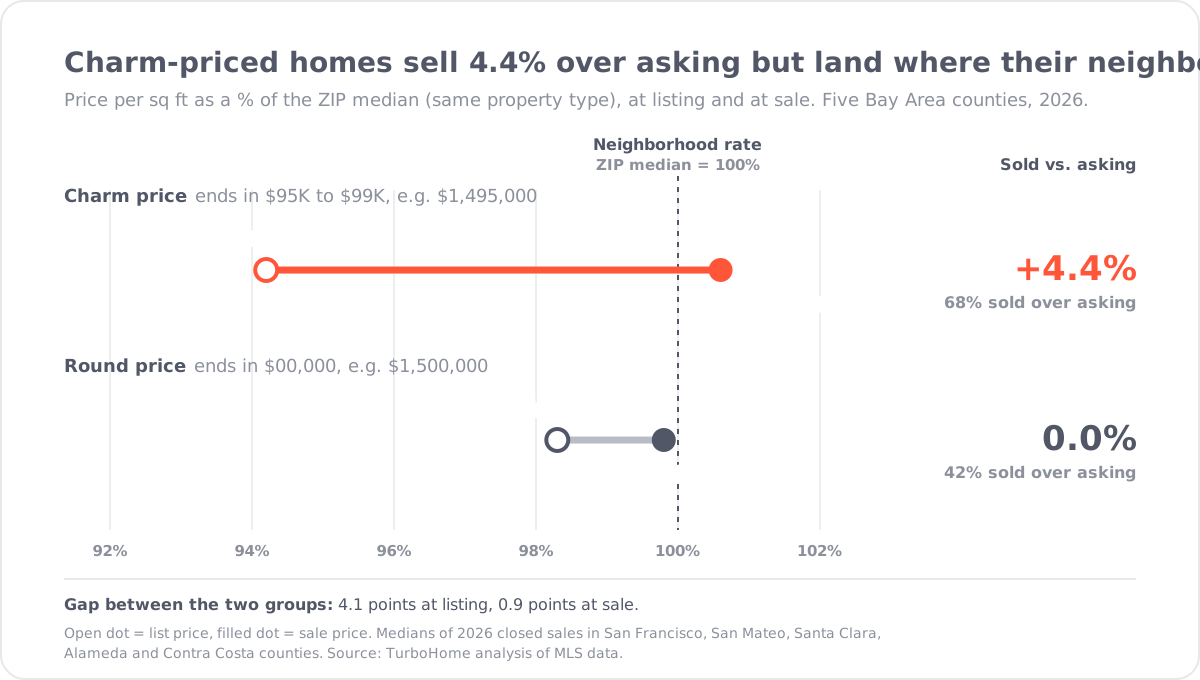
- Charm-priced homes started 5.8% below the neighborhood rate. They were listed at a median 94.2% of their ZIP’s price per square foot and sold at 100.6%.
- Round-number homes started 1.7% below it. They were listed at 98.3% and sold at 99.8%.
Here’s the key line: a 4.1-point gap at listing shrinks to 0.9 points at close. About four-fifths of the difference in overbids comes from the lower starting price.
So the 68% of charm-priced homes that sold over asking mostly paid the going rate. Their 4.4% “overbid” was the market closing the gap the seller left at listing. Buyers did pay a little more against the benchmark, 0.9 points, but nothing like the headline.
That also explains the headlines. Where many homes are listed below market, sale-to-list ratios will look like a frenzy even when buyers are paying neighborhood rates.
San Francisco, the extreme case
San Francisco takes teaser pricing furthest.
- Charm-priced SF homes were listed at a median 84.8% of their ZIP’s price per square foot, about 15% under the neighborhood rate.
- They sold at a median 119.7% of asking, nearly 20% over.
- They closed at 102.6% of the ZIP benchmark.
Round-number SF listings tell the opposite story. They sold at a median 102.9% of asking, a “modest” 2.9% over. But they closed at 104.6% of the ZIP benchmark, 2 points higher than the charm-priced homes.
Put plainly, the SF buyer who paid nearly 20% over a teaser price bought closer to the neighborhood rate than the buyer who paid 3% over a round number. The small overbid was the pricier purchase.
What this means for buyers: offer off comps, not the asking price
If you’re shopping for a $1M to $3M home in the Bay Area, the asking price tells you the seller’s strategy. It doesn’t tell you what the home is worth. Here’s how to set an offer from comps instead:
- Pull 3 to 6 recent sales in the same ZIP. Same property type, similar size, closed recently. Your agent can pull these from the MLS.
- Compute price per square foot for each. Divide the sale price by the living area, then look at where the middle of the range sits.
- Adjust for this home. Condition, layout, lot size, parking and views all move value. A remodeled kitchen or bigger lot points to the top of the range. A home that needs work belongs near the bottom.
- Multiply by the home’s square footage. That’s your estimate of market value before competition.
- Treat the list price as a floor signal only. A price ending in $95K to $99K usually means the seller expects offers above it. In our data, those listings started about 6% below the neighborhood rate. A round number usually means the seller priced close to market.
Watch the appraisal gap, too. Lenders base the loan on the appraised value, and appraisers work from comparable sales. If you pay far above what similar homes nearby sold for, the appraisal can come in low, and you may need to cover the difference in cash. Pricing off comps keeps that risk in view.
And remember the San Francisco lesson: a 20% overbid on a teaser price can still be a market-rate purchase, and a 3% overbid on a round number can be the more expensive home. Compare offers in dollars per square foot, not percent over asking. Our winning offer strategy page covers the rest of the offer.
What this means for sellers: underpricing isn’t a free bidding war
The standard advice is “list low to start a bidding war.” The data says that buys less than it seems.
- It doesn’t reliably buy a higher price. Across the five counties, charm-priced homes closed just 0.9 points higher against their ZIP benchmark than round-number homes. In San Francisco and San Mateo, they closed lower. In Contra Costa, the two groups closed even.
- It does buy fewer price cuts. 12.5% of charm-priced sales had a price cut, against 17.8% of round-number sales, at similar speed (a median 13 vs. 12 days on market).
That’s a real benefit, but a smaller one than a 4.4% overbid suggests. The bigger lever is pricing near market and marketing the home well. Our 15-day cliff analysis found that Bay Area homes earn their premium in the first two weeks on market, so a list price set from the comps matters more than a teaser number.
For investors and market watchers, the lesson is about measurement. Sale-to-list ratios overstate demand wherever teaser pricing is common. To compare markets, use closed price per square foot against a local benchmark, not percent over asking.
For more Bay Area data, see our analysis of San Francisco condo vs. house prices per square foot and our city-by-city guide to how much over asking homes sell for.
Methodology notes
- Source: TurboHome analysis of MLS closed sales.
- Geography: San Francisco, San Mateo, Santa Clara, Alameda and Contra Costa counties.
- Date range: Closings from January 1 to November 3, 2026. The 2019 share comparison uses 2019 closings.
- Sample size: 23,625 closed sales in 2026.
- Price groups: Charm prices are original list prices whose last five digits fall between $95,000 and $99,999 (for example, $1,495,000). Round prices end in $00,000 (for example, $1,500,000). Sales with other endings count toward the total but are not part of the two-group comparison.
- Metrics: Medians throughout. Sale-to-list and “sold over asking” use the original list price, so price cuts count against the sale. Relative price per square foot divides each home’s price per square foot, at its original list price and at its sale price, by the 2026 median for the same ZIP code and property type.
- Caveats: The ZIP benchmark controls for location and property type, not for condition, layout, views or lot size, so charm-priced and round-number homes may differ in ways it can’t see. County-level readings, especially for round-number listings (6% of sales), rest on smaller samples. Off-MLS sales are excluded.
- MLS attribution: Data in this report is derived from MLS closed-sale records and is provided for informational purposes only. It has not been independently verified by the Multiple Listing Service and may differ from figures published by MLS associations due to differing cutoff dates, cleaning rules, or geographic groupings.
Sources & further reading
- Bay Area Housing Market Update: Week of October 23, 2026 (David Park Homes): September sale-to-list by county, from MLSListings via agent analysis.
- 9 in 10 S.F. homes are now selling for more than asking — sometimes much more (San Francisco Chronicle, October 26, 2026)
These third-party sources use their own methods and reporting windows and may not match TurboHome’s figures exactly. They are included as context, not as the underlying data for this report.
Frequently asked questions
How much over asking should I offer in the Bay Area?
Set your offer from recent comparable sales, not from a percentage over asking. In TurboHome’s analysis of 23,625 2026 sales in San Francisco, San Mateo, Santa Clara, Alameda and Contra Costa counties, homes listed at a price ending in $95,000 to $99,999 sold a median 4.4% over asking, but closed at 100.6% of their ZIP’s median price per square foot. Pull 3 to 6 recent sales in the same ZIP, compute price per square foot, adjust for condition and lot, and treat the list price as a floor signal only.
Why do Bay Area homes sell so far over asking?
Mostly because many are listed below market on purpose. 41% of 2026 sales in five Bay Area counties were listed at a price ending in $95,000 to $99,999, and those homes were listed a median 5.8% below their ZIP’s going rate per square foot. When they sold, they closed at 100.6% of that rate. Most of the overbid closes the gap the seller left at listing.
What does a list price ending in $95,000 or $99,000 mean?
It usually signals a teaser price. In 2026, Bay Area homes listed at prices like $1,495,000 started at a median 94.2% of their ZIP’s price per square foot, and 68% sold over asking. Homes listed at a round $X00,000 price started at 98.3% of the ZIP rate, and 42% sold over asking.
Should I list my Bay Area home low to start a bidding war?
Underpricing does not reliably buy a higher final price. Across five Bay Area counties in 2026, charm-priced homes closed 0.9 points higher than round-number homes against their ZIP benchmark, and lower in San Francisco and San Mateo. What it did buy was fewer price cuts: 12.5% of charm-priced sales had one, against 17.8% of round-number sales.
Talk to a TurboHome agent before your next offer
Whether a home is listed at $1,495,000 or $1,500,000, the number that matters is what similar homes nearby actually sold for. TurboHome agents price every offer off live comps, and because we work on a flat fee, our pay doesn’t rise when your offer does.
About the Author
Lucas Beard
Lucas Beard is COO of TurboHome and holds California DRE license 02417843. His guides reflect TurboHome's buyer-side experience and link to primary sources for regulatory, lender, market, and competitor claims.
View Lucas on LinkedInAbout Kevin Kretzmer
Head Agent, California
Kevin Kretzmer leads TurboHome's California agent team and reviews California and national buyer guidance for practical brokerage accuracy.
View Kevin's profile