San Francisco Market Analysis
Is Parking Worth It? What a Garage Space Adds to a San Francisco Condo Price in 2026

Reviewed by:

Head Agent, California · CalDRE #01997822
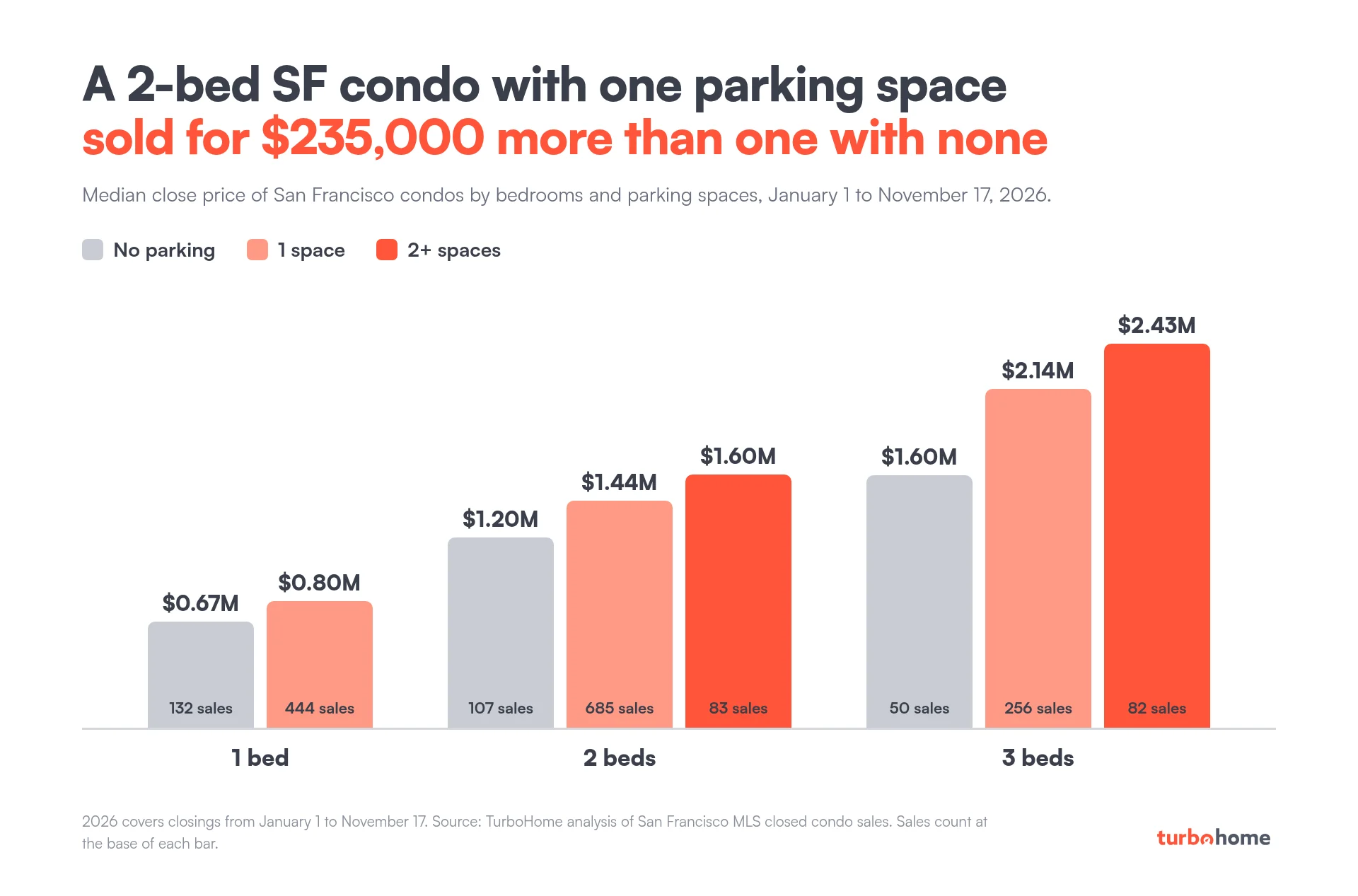
In 2026, a 2-bedroom San Francisco condo with one parking space sold for a median $1,435,000. One with no parking sold for $1,200,000. That $235,000 gap is real, but part of it is size. Per square foot, parking added 12% to a 2-bed, and for 1-beds it added nothing at all.
TurboHome Market Analysis · San Francisco · Updated November 18, 2026
The short answer: parking is worth paying for in a 2- or 3-bedroom SF condo, where it added 12% to 26% per square foot this year. In a 1-bedroom, the parking units sold for 3% less per square foot, so you’re paying for the extra space, not the garage.
The question matters more this month because condos got more competitive. In October, the San Francisco condo median rose 12% from a year earlier to $1,344,500, 68% of condos sold over asking, and active condo listings fell 24% to 545 (Prism Group, November 2026 report). The 30-year mortgage rate fell to 7.11%, its fourth straight weekly drop (Freddie Mac via GlobeNewswire; IfYouSpent). With fewer listings, more buyers are deciding whether to stretch for a unit with a space.
What parking adds: 2026 sale prices by bedrooms and spaces
We pulled every San Francisco condo sale in the MLS from January 1 to November 17, 2026, and grouped them by bedrooms and parking spaces. That’s 1,839 sales.
| Bedrooms | Parking | Sales | Median price | Median $/sq ft | Median sq ft | Median sale-to-list | Median days on market |
|---|---|---|---|---|---|---|---|
| 1 | None | 132 | $668,500 | $993 | 674 | 100% | 31 |
| 1 | 1 space | 444 | $799,000 | $963 | 807 | 100% | 22 |
| 2 | None | 107 | $1,200,000 | $1,087 | 1,038 | 106% | 15 |
| 2 | 1 space | 685 | $1,435,000 | $1,219 | 1,200 | 104% | 13 |
| 2 | 2+ spaces | 83 | $1,599,000 | $1,191 | 1,316 | 107% | 15 |
| 3 | None | 50 | $1,595,000 | $1,034 | 1,512 | 108% | 15 |
| 3 | 1 space | 256 | $2,137,000 | $1,308 | 1,639 | 113% | 13 |
| 3 | 2+ spaces | 82 | $2,425,000 | $1,220 | 1,829 | 107% | 16 |
Here is the raw gap between each parking group and no-parking condos with the same number of bedrooms:
| Unit | Price gap vs. no parking | In percent |
|---|---|---|
| 1-bed, 1 space | $130,500 | +20% |
| 2-bed, 1 space | $235,000 | +20% |
| 2-bed, 2+ spaces | $399,000 | +33% |
| 3-bed, 1 space | $542,000 | +34% |
| 3-bed, 2+ spaces | $830,000 | +52% |
Most SF condos come with a space. Only 12% of 2-bedroom sales and 13% of 3-bedroom sales had no parking. For 1-bedrooms it was 23%.
Size vs. parking: why per square foot tells a different story for 1-beds
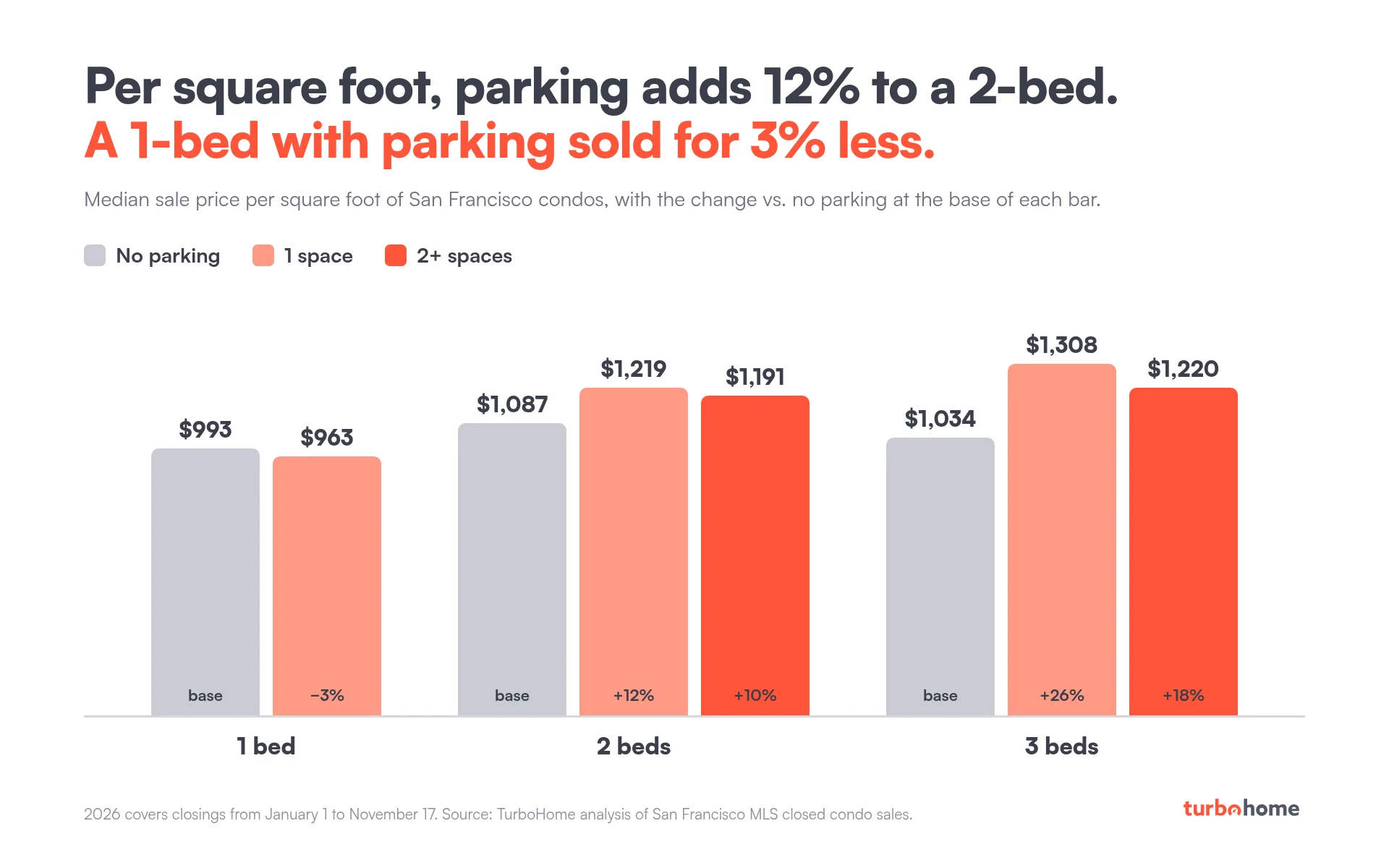
Units with parking are also bigger. The median 1-bed with a space had 807 square feet, 20% more than the 674 in a 1-bed without one. For 2-beds the difference was 16%, and for 3-beds 8%. So the raw price gap mixes two things: more space and the parking itself.
Price per square foot pulls them apart:
- 1-beds: parking added nothing. Units with a space sold for $963 per square foot, 3% less than the $993 for units without. Price the median 807 sq ft parking unit at the no-parking rate and you get $801,351, almost exactly its $799,000 median. The whole $130,500 gap is size.
- 2-beds: parking added about $130,600. At the no-parking rate of $1,087, a 1,200 sq ft unit comes to $1,304,400. The median 1-space unit sold for $1,435,000. A second space added little more per foot: 10% over no parking, compared with 12% for one space.
- 3-beds: the biggest premium, the smallest sample. One space added 26% per square foot. But only 50 no-parking 3-beds sold this year, so treat this number as rough.
Parking is not the only difference between these groups. Buildings with garages also tend to differ in age, amenities and neighborhood, and our data does not separate those out. Think of the per-square-foot premium as the most you can credit to the space, not a precise appraisal. For how building age affects price per foot, see our old vs. new Bay Area homes analysis.
Deeded, assigned, leased or tandem: what you actually own
“1 parking space” on a listing can mean very different things. How the space is held decides whether it’s yours to keep, sell or lose.
| Type | What it means | What to check |
|---|---|---|
| Deeded | The space is described in your grant deed and is part of what you own. | The grant deed and preliminary title report. Whether the CC&Rs let you sell or rent the space separately. |
| Assigned | The HOA owns the space as common area, and your unit gets exclusive use under the building’s declaration (Civil Code 4145). | Whether the space is assigned to your unit in the recorded declaration or condo plan, or only by a board list. |
| Leased | You rent the space from the HOA, a garage operator or the developer. It does not transfer when you sell. | Monthly cost, notice period and whether the lease passes to the next owner. |
| Tandem | Two cars parked nose to tail in one lane, so one blocks the other. | Whether “2 spaces” on the listing means two side-by-side spaces or one tandem lane. Who parks in front if the lane is shared. |
Three rules shape SF condo parking in particular:
- The board can’t hand out common area freely. In California, an HOA board generally needs a vote of owners holding at least 67% of the units to grant exclusive use of common area, unless the governing documents say otherwise. Assigning a space the declaration already designates for assignment is an exception (Civil Code 4600). An assigned space written into the recorded documents is safer than one that depends on a board list.
- Newer buildings sell parking separately. In new SF buildings with 10 or more units, parking must be sold or leased separately from the unit, and three-bedroom buyers get first offer when spaces run short (SF Planning Code Section 167). A no-parking unit in a newer building may still have a space you can buy or rent.
- New buildings don’t have to include parking at all. San Francisco eliminated minimum parking requirements citywide in 2018 (Board of Supervisors File 181028), so more new condos will come with fewer spaces than units.
If you plan to drive an electric car, also ask whether the space can take a charger and who pays for the wiring. Our SF HOA fees guide covers what dues typically include.
Monthly math: renting a garage nearby vs. financing the space
If you buy without parking, you can rent a space instead. Here’s how that compares with financing the premium, using 20% down, a 30-year fixed rate of 7.11% and San Francisco’s 1.1827% property tax rate (SF Board of Supervisors, Resolution 447-25).
| Option | Upfront | Monthly cost |
|---|---|---|
| Residential parking permit (street) | none | about $19 ($224 a year) |
| City garage, regular monthly | none | $255 to $330 |
| City garage, reserved space | none | $350 to $440 |
| Finance the 2-bed per-sq-ft premium (about $130,600) | $26,120 | about $832 |
| Finance the full 2-bed gap ($235,000) | $47,000 | about $1,496 |
Where the numbers come from:
- Street parking uses the SFMTA residential parking permit fee of $224 a year, which exempts you from posted time limits but does not guarantee a space.
- Garages use posted monthly rates at three city-run garages: Japan Center ($255 regular, $350 reserved), Mission-Bartlett ($295 regular, $385 reserved) and Civic Center ($330 regular, $440 reserved). Several have waiting lists, and private garages near your building may charge more.
- Financed costs are principal, interest and property tax only. They leave out any extra HOA dues tied to the space.
On these numbers, financing the 2-bed parking premium costs roughly twice as much a month as a reserved city garage space. Two things narrow that gap. Part of each mortgage payment pays down principal, and the space’s value comes back to you when you sell, if parking premiums hold. Renting is cheaper and flexible, but a garage three blocks away is not the same as an elevator to your car, and waiting lists can run long.
For context, an SFMTA survey of large buildings found unbundled condo spaces renting for up to $450 a month or selling for $50,000 to $100,000 or more (SFMTA Large Building Study, 2019). That survey is several years old, so treat it as a rough range.
Resale: how fast no-parking condos sell and who they suit
No-parking condos still sell, and the difference is smaller than most buyers expect:
- 1-beds wait longest. The median no-parking 1-bed took 31 days to sell, compared with 22 for a 1-bed with a space. Both sold at a median 100% of list.
- 2-beds barely notice. No-parking 2-beds took 15 days, two more than 1-space units, and sold at 106% of list, more over asking than the 104% for units with a space.
- 3-beds give up overbid. No-parking 3-beds sold at 108% of list, while 3-beds with one space sold at 113%. That’s the one group where parking showed up clearly in the overbid.
A slower sale matters most past day 15. In our Bay Area days-on-market analysis, SF homes held 123% to 124% of original list price from day 4 through day 14, then dropped to 110.2% on days 15 to 21. A no-parking 1-bed that sits a month gives its buyer more room to negotiate, which helps you as a buyer and costs you as a future seller.
Our sales data does not record who bought each unit. What it shows is that 23% of 1-bed sales and about 12% of larger condo sales had no parking, so you’ll be selling into a smaller slice of the market. A no-parking unit suits buyers who don’t drive daily, live near transit and work, or already rent a garage nearby.
When to skip parking and when to pay up
Skip parking when:
- You’re buying a 1-bed. Parking added nothing per square foot this year, so you’d pay only for extra space.
- You don’t own a car, or you drive rarely enough that a permit or occasional garage costs less than $832 a month.
- The building sells or leases spaces separately, so you can add one later.
- You want to win the unit. With 68% of October condos selling over asking, a no-parking unit can be the one you can afford to bid on.
Pay up for parking when:
- You’re buying a 2- or 3-bed, where parking added 12% to 26% per square foot and most buyers expect a space.
- You plan to sell within a few years, especially a 3-bed, where no-parking units gave up five points of overbid.
- The space is deeded or assigned in the recorded documents, not leased or subject to a board list.
- You need EV charging, which is far easier to install in a space you control.
Before you offer on any condo, read the parking section of the CC&Rs and condo plan, confirm the space on the title report, and ask the HOA for its parking rules and any waiting list. If the listing says two spaces, ask whether they’re tandem.
For more San Francisco condo data, see our SF condo seller credits analysis, house vs. condo in San Francisco, SF days on market and how San Francisco realtor fees work.
Frequently asked questions
How much is a parking space worth in a San Francisco condo?
In TurboHome’s MLS data for January 1 to November 17, 2026, the median San Francisco 2-bedroom condo with one parking space sold for $1,435,000 and the median 2-bedroom with no parking for $1,200,000, a $235,000 gap. Part of that is size: the parking units were 16% bigger. Per square foot, the premium was 12%, which works out to about $130,600 on a median 1,200 sq ft unit. For 1-bedrooms, units with parking sold for 3% less per square foot.
Do San Francisco condos without parking sell slower?
A little, and mostly for 1-bedrooms. In 2026 the median 1-bedroom condo with no parking took 31 days to sell, compared with 22 days for a 1-bedroom with one space. For 2- and 3-bedrooms the gap was two days (15 vs. 13). No-parking 2-bedrooms actually sold further over list price, at a median 106% vs. 104%.
What is the difference between deeded and assigned parking in an SF condo?
Deeded parking is described in your grant deed, so you own it as real property. Assigned parking is usually common area owned by the HOA, with your unit given exclusive use under the building’s declaration (California Civil Code 4145). Assigned spaces that are not written into the recorded documents can be harder to rely on. Leased parking is rented month to month and does not transfer when you sell.
Is it worth buying a condo without parking in San Francisco?
It can be if you don’t own a car or can rent a space nearby. For 1-bedrooms, parking added nothing per square foot in 2026, so a no-parking 1-bed is not a discount you’ll pay for later. For 2- and 3-bedrooms, parking units sold for 12% to 26% more per square foot, and those buyers will expect a space when you sell.
How much does it cost to rent a garage space in San Francisco?
City-run SFMTA garages post regular monthly rates of $255 at Japan Center, $295 at Mission-Bartlett and $330 at Civic Center, and reserved spaces of $350 to $440, often with a waiting list. A residential parking permit costs $224 a year but does not guarantee a space on the street.
Methodology
- Source: TurboHome analysis of MLS closed condo sales in the City and County of San Francisco.
- Date range: Closings from January 1 to November 17, 2026.
- Groups: 1-, 2- and 3-bedroom condos, grouped by the number of parking spaces on the listing: none, one, or two or more. No 1-bedroom group with two or more spaces is shown. The listing count does not say whether a space is deeded, assigned, leased or tandem.
- Per-square-foot premium: The median price per square foot of each parking group compared with the no-parking group of the same bedroom count. The size-adjusted dollar figure multiplies the parking group’s median size by the no-parking group’s median price per square foot.
- Monthly costs: 20% down, 30-year fixed at 7.11%, property tax at 1.1827% of price. Estimates only; your loan terms and tax bill will differ.
Sources and further reading
- November 2026 San Francisco Market Report (Prism Group): October condo median, share sold over asking and active listings.
- Mortgage Rates Decline for Fourth Consecutive Week to 7.11% (Freddie Mac via GlobeNewswire, November 12, 2026)
- Mortgage rates post fourth weekly decline (IfYouSpent, November 2026)
- SF Planning Code Section 167: parking costs separated from housing costs
- SF Board of Supervisors File 181028: eliminating minimum parking requirements
- California Civil Code 4145: exclusive use common area and Civil Code 4600: granting exclusive use
- SFMTA residential parking permits and garage rates for Japan Center, Mission-Bartlett and Civic Center
- SFMTA Large Building Study, property manager survey (2019)
These third-party sources use their own methods and reporting windows and may not match TurboHome’s figures exactly.
Find the right condo, with or without a space
A TurboHome agent can pull per-square-foot comps for the buildings you’re watching, check how a space is held before you offer, and price your bid. You pay a flat fee, not a percentage that grows with every overbid.
About the Author
Lucas Beard
Lucas Beard is COO of TurboHome and holds California DRE license 02417843. His guides reflect TurboHome's buyer-side experience and link to primary sources for regulatory, lender, market, and competitor claims.
View Lucas on LinkedInAbout Kevin Kretzmer
Head Agent, California
Kevin Kretzmer leads TurboHome's California agent team and reviews California and national buyer guidance for practical brokerage accuracy.
View Kevin's profile