Bay Area Market Analysis
Seller Credits and Rate Buydowns on San Francisco Condos: Which Listings Still Say Yes in 2026

By Lucas Beard
COO, TurboHome · Last updated November 16, 2026
Reviewed by:

Head Agent, California · CalDRE #01997822
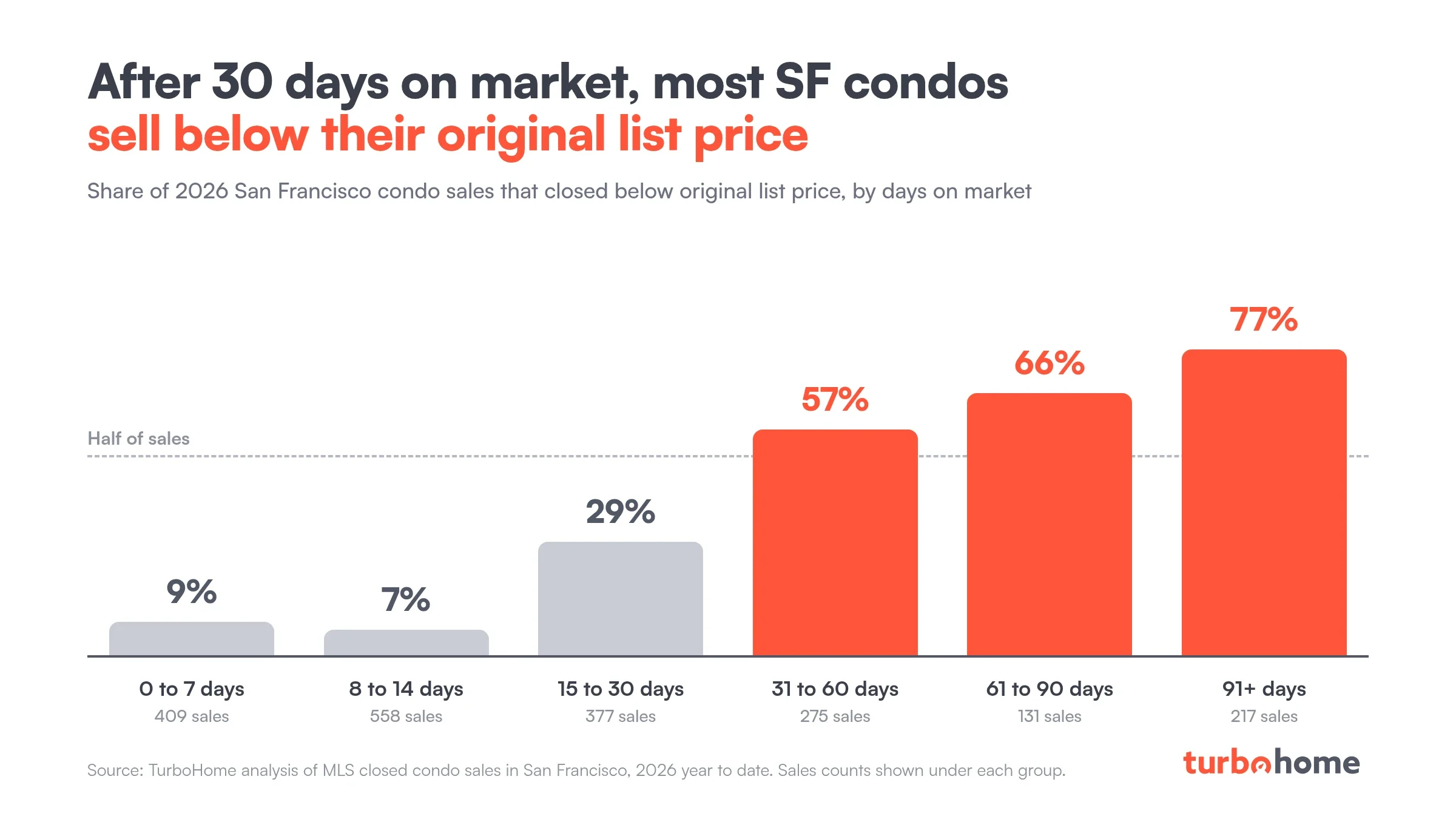
A $20,000 seller credit on a $980,000 San Francisco condo can cut your monthly payment about three times as much as a $20,000 price cut, if you use it to buy down your rate. The hard part is finding a seller who will pay it. In 2026, 57% of SF condos that sold after 31 to 60 days on market closed below their original list price. Among condos that sold in the first two weeks, 7% to 9% did.
TurboHome Market Analysis · San Francisco · Published November 16, 2026
The short answer: ask for a rate buydown credit on SF condos that have been listed more than 30 days, not on fresh listings drawing overbids. Size the credit to your lender’s cap and to what one point actually buys. If you expect to refinance within a few years, ask for a price cut instead.
Rates give you a reason to ask now. Freddie Mac’s 30-year average fell for a fourth straight week to 7.11% on November 12, down from a 7.40% peak in October but up from 6.24% a year ago (United States Real Estate Investor). The market gives you less room than it did a year ago, though. In TurboHome MLS data, the share of SF condos closing below list price fell from 41% in Q4 2025 to 15% so far in Q4 2026. A credit now depends on picking the right listing.
Seller credit vs. price cut: what each does to your payment
To the seller, a $20,000 credit and a $20,000 price cut cost about the same. To you, they work very differently. A price cut shrinks your loan a little. A credit spent on discount points lowers the rate on the whole loan.
Here is one example. It uses a $980,000 condo, close to the $979,888 median price of SF condos that sold after 31 to 60 days in 2026, with 20% down and a 30-year fixed rate of 7.11%. For the credit, we assume each point (1% of the loan) lowers the rate by 0.25 percentage points. Lenders price points differently by day and by loan, so ask for your own quote (CFPB).
| No concession | $20,000 price cut | $20,000 credit for points | |
|---|---|---|---|
| Price | $980,000 | $960,000 | $980,000 |
| Loan at 20% down | $784,000 | $768,000 | $784,000 |
| Rate | 7.11% | 7.11% | about 6.47% |
| Monthly principal and interest | $5,274 | $5,166 | $4,941 |
| Monthly savings | $108 | $333 |
The credit wins on payment by about $225 a month in this example. It takes about 60 months of that $333 in savings to add up to the $20,000 the points cost. The price cut is the better ask when:
- You expect to refinance soon. If rates keep falling and you refinance in two years, most of what the points bought is gone.
- The appraisal may come in low. A price cut lowers the number the lender works from. A credit keeps the price high.
- Cash to close is tight. At 20% down, a $20,000 price cut also lowers your down payment by $4,000.
A price cut also trims your property tax, since California taxes start from the purchase price.
How a rate buydown works, and how much a seller can credit
There are two kinds of buydown, and a seller credit can pay for either.
- Permanent buydown (discount points). One point costs 1% of the loan amount and lowers your rate for the life of the loan. Points appear on page 2, section A of your Loan Estimate (CFPB).
- Temporary buydown (2-1). The rate is 2 points lower in year one and 1 point lower in year two, then returns to the note rate. On the $784,000 loan above, that means payments of about $4,262 in year one and $4,756 in year two before $5,274 from year three. It costs about $18,365 up front. Under Fannie Mae rules you still qualify at the full note rate, and the reduction can’t exceed 3 points or last more than 3 years (Fannie Mae).
Lenders cap how much a seller can credit you. A seller-funded buydown counts toward the same cap as any other seller credit.
| Loan type | Maximum seller credit | Based on |
|---|---|---|
| Conventional, less than 10% down | 3% | Lower of price or appraised value |
| Conventional, 10% to 25% down | 6% | Lower of price or appraised value |
| Conventional, more than 25% down | 9% | Lower of price or appraised value |
| Conventional, investment property | 2% | Lower of price or appraised value |
| FHA | 6% | Sales price |
| VA | 4% of concessions (normal closing costs and points don’t count) | Reasonable value |
Conventional limits are from Fannie Mae’s Selling Guide. FHA and VA limits are from HUD and VA guidance, summarized by Home Stimulus.
Three rules trip up SF condo buyers:
- The credit can’t exceed your closing costs. Under Fannie Mae rules, anything above your actual costs is treated as a price reduction. It can’t fund your down payment or reserves either.
- Jumbo loans have their own caps. The 2026 conforming limit tops out at $1,249,125 in the highest-cost areas (FHFA). Above your county’s limit, the lender sets the cap. Get it in writing before you offer.
- Agent rebates count too. Fannie Mae treats a rebate from a real estate agent as an interested party contribution. If your agent credits you part of the commission, as TurboHome does, plan the rebate and the seller credit together so both fit under the cap.
In the example above, 20% down puts the cap at 6%, or $58,800. A $20,000 credit fits easily, as long as your closing costs including points are at least that much.
Which SF condos still sell under list
Days on market is the clearest signal, as the chart at the top shows. In 2026, condos that sold in their first two weeks almost never went under list. After 30 days, most did.
| Days on market | 2026 condo sales | Closed below original list | Median sale-to-list | Median price |
|---|---|---|---|---|
| 0 to 7 | 409 | 9% | 108.9% | $1,554,000 |
| 8 to 14 | 558 | 7% | 114.3% | $1,552,500 |
| 15 to 30 | 377 | 29% | 101.5% | $1,150,000 |
| 31 to 60 | 275 | 57% | 99.6% | $979,888 |
| 61 to 90 | 131 | 66% | 100.0% | $920,000 |
| 91 or more | 217 | 77% | 97.8% | $700,000 |
Here’s how to read it.
- Day 30 is the line. The share closing below original list jumps from 29% at 15 to 30 days to 57% at 31 to 60 days, and keeps climbing. Of 1,967 SF condo sales in the table, 623, or 32%, closed after day 30.
- Sellers past day 30 settle near list, not far below it. Median sale-to-list stays between 97.8% and 100.0%. That makes a credit of a few percent an easier ask than a deep price cut, because the seller can still record a sale close to list.
- Long-sitting condos are a cheaper slice of the market. The median price falls from about $1.55 million in the first two weeks to $979,888 at 31 to 60 days and $700,000 after 90 days. That’s mostly a different mix of units, not a discount on the same ones. It also means more of these loans fit under conforming limits, where the caps above are clear.
The building matters as much as the clock. Before you ask for a credit on a condo that has sat, read the HOA budget, reserve study, minutes and any special assessment notices. High dues weigh on price: our Bay Area HOA fees analysis found each extra $100 a month of dues came with about $9,160 less in SF sale price in 2026. Check the listing history too. A condo that was pulled and relisted can show a fresh days-on-market count, as our relisted homes analysis shows.
How to write the credit into your offer
- Get your lender’s numbers first. Ask what one point costs and what it buys, what a 2-1 buydown costs, your cap at your down payment, and your estimated closing costs.
- Offer near list with a credit. For example, $980,000 with a $20,000 seller credit toward the buyer’s closing costs, including discount points or a temporary buydown. The seller keeps the headline price. You get the lower payment.
- Say what happens if the lender allows less. Agree up front on how any unusable part of the credit is handled, such as a matching price reduction, so it isn’t lost at closing.
- Keep your appraisal and loan contingencies. Conventional caps are based on the lower of price or appraised value, so a low appraisal can shrink the credit you can use.
- Put a temporary buydown in writing. Fannie Mae requires a written buydown agreement, and its terms must be disclosed to the appraiser.
- Use the listing’s history as your case. Days on market, price cuts and canceled escrows tell the seller’s agent you’ve done the homework. Our San Francisco days on market guide and SF price cut data give you the baseline.
Locking your rate while rates swing week to week
Rates fell four weeks in a row through November 12, but the same report noted Realtor.com’s warning that a reversal could come as soon as the next week. The rate your credit buys is set when you lock, so timing matters.
- Lock once the credit is in contract. You need the final credit amount to price the points.
- Cover the whole escrow. Rate locks are typically available for 30, 45 or 60 days, and sometimes longer. Extending one can be expensive (CFPB).
- Ask what happens if rates fall after you lock. Policies vary by lender. Some offer a float-down option, often for a fee.
- Don’t change the file after locking. A locked rate can still change if your loan amount, credit score or verified income changes.
When a fresh listing with overbids is still the better deal
A credit is a tool, not a reason to buy the wrong condo. A fresh listing can be the better deal when:
- It’s the unit you want. Nearly half of 2026 SF condo sales, 967 of 1,967, closed within two weeks at median sale-to-list ratios of 108.9% and 114.3%. Well-located units with parking or good layouts often go fast.
- The list price is a lure. Some SF sellers price low to draw offers. Judge the sale price against recent sales per square foot, as our SF list price vs. sale price analysis explains.
- The condo that sat has a real problem. A $20,000 credit won’t cover a large special assessment, thin reserves or a building that lenders won’t finance.
- You plan to refinance soon. If rates keep falling, you’d get little from points. A fair price on the right unit may matter more.
For more SF condo context, see our analysis of San Francisco condo vs. house prices and San Francisco HOA fees.
Methodology notes
- Source: TurboHome analysis of MLS closed-sale records.
- Geography: San Francisco County.
- Sample: 1,967 condo sales closed in 2026 to date, grouped by days on market.
- Closed below original list: The share of sales with a final sale price below the first list price.
- Quarterly comparison: Share of SF condos closing below list price, Q4 2025 compared with Q4 2026 to date.
- Payment math: 30-year fixed principal and interest only, excluding taxes, insurance and HOA dues. The points example assumes 0.25 percentage points of rate reduction per point. Your lender’s pricing will differ.
- MLS attribution: Data in this report is derived from MLS closed-sale records and is provided for informational purposes only. It has not been independently verified by the Multiple Listing Service and may differ from figures published by MLS associations due to differing cutoff dates, cleaning rules, or geographic groupings.
Sources & further reading
- Mortgage Rates Fell a Fourth Straight Week to 7.11% (United States Real Estate Investor, November 12, 2026): Freddie Mac weekly rates and the 7.40% October peak.
- Interested Party Contributions (Fannie Mae Selling Guide B3-4.1-02): seller credit caps, closing cost limits and agent rebates.
- Temporary Interest Rate Buydowns (Fannie Mae Selling Guide B2-1.4-04): qualifying rate and buydown limits.
- How should I use lender credits and points? (CFPB): how discount points work.
- What’s a rate lock? (CFPB): lock periods and questions to ask.
- FHFA 2026 conforming loan limits: baseline and high-cost limits.
- Seller Concessions: Closing Cost Limits by Loan Type (Home Stimulus): FHA and VA limits.
These third-party sources use their own methods and reporting windows and may not match TurboHome’s figures exactly. Loan rules change, and your lender’s program governs what you can use.
Frequently asked questions
Can I ask the seller to buy down my mortgage rate on a San Francisco condo?
Yes. Ask for a seller credit toward your closing costs and use it for discount points (a permanent buydown) or a temporary buydown such as a 2-1. Your odds depend on the listing. In TurboHome’s 2026 MLS data, 57% of SF condos that sold after 31 to 60 days on market closed below their original list price, compared with 7% to 9% of condos that sold in the first two weeks.
How much can a seller credit a buyer toward closing costs?
It depends on the loan. Under Fannie Mae’s rules for a primary residence, the cap is 3% of the lower of the price or appraised value with less than 10% down, 6% with 10% to 25% down, and 9% with more than 25% down. FHA allows 6% of the sales price. VA caps concessions at 4% of reasonable value, but normal closing costs and discount points don’t count toward it. Jumbo lenders set their own limits, and a credit can never be more than your actual closing costs.
Is a seller credit better than a price cut?
Often, if you keep the loan for years. On a $980,000 condo with 20% down at 7.11%, a $20,000 price cut lowers principal and interest by about $108 a month. The same $20,000 spent on discount points could lower it by about $333 a month, assuming each point cuts the rate by 0.25 percentage points. A price cut is the better ask if you expect to refinance within a few years or the appraisal may come in low.
How long do San Francisco condos sit on the market?
Most sell fast, but a large minority don’t. In TurboHome’s 2026 MLS data, 967 of 1,967 San Francisco condo sales (49%) closed within 14 days on market, and 623 (32%) closed after more than 30 days.
Which San Francisco condos are most likely to accept a seller credit?
Condos that have been listed more than 30 days. In 2026, 57% of SF condos that sold after 31 to 60 days closed below original list, rising to 66% at 61 to 90 days and 77% at 91 days or more. Check the listing history too, since a relisted condo can show a fresh days-on-market count.
Get the credit on the right condo
TurboHome agents pull days on market, price cut history and building sales from our own MLS data before you write an offer, then size the credit to your lender’s cap. Our flat-fee model means you keep thousands back at closing.
About the Author
Lucas Beard
Lucas Beard is COO of TurboHome and holds California DRE license 02417843. His guides reflect TurboHome's buyer-side experience and link to primary sources for regulatory, lender, market, and competitor claims.
View Lucas on LinkedInAbout Kevin Kretzmer
Head Agent, California
Kevin Kretzmer leads TurboHome's California agent team and reviews California and national buyer guidance for practical brokerage accuracy.
View Kevin's profile