Bay Area Market Analysis
Do Open Houses Still Matter? Bay Area Houses That Skip One Sell for 1.7% Less

Reviewed by:

Head Agent, California · CalDRE #01997822
Ask around about open houses this fall and you’ll hear they’re mostly theater. An Inman column on November 3 tells agents to stop asking the open house to sell the house. Agents quoted by Florida Realtors say open houses draw unqualified visitors and “rarely lead directly to offers.” Redfin’s seller guide says there is only “some evidence” they help. Almost nobody shows what happens to the sale price, so we checked.
TurboHome Market Analysis · Bay Area · Published November 10, 2026
The short answer: open houses still matter for Bay Area houses. Single-family homes that skipped a public open house in their first 10 days on market sold a median 1.7% below matched comps in both 2025 and 2026. Houses with two or more open-house days sold at or slightly above comps. That gap of about 1.9 points is roughly $27,000 on a $1.4 million house.
Skipping isn’t rare, either. In 2026, 2,616 of 15,686 qualifying single-family sales (16.7%), about 1 in 6, had no public open house in their first 10 days.
Do open houses help sell a house? What 34,959 Bay Area sales show
We looked at 34,959 single-family sales in San Francisco, Alameda, Contra Costa, San Mateo and Santa Clara counties that closed between January 1, 2025 and November 9, 2026. For each sale, we compared its price per square foot with the median for homes sold the same year in the same ZIP, the same size range and the same condition score. Then we grouped sales by how many days the home was open to the public in its first 10 days on market.
One adjustment matters. We left out homes that went pending within 10 days of listing. Otherwise a home that sold in three days would count as “no open house” only because it never had the chance to hold one.
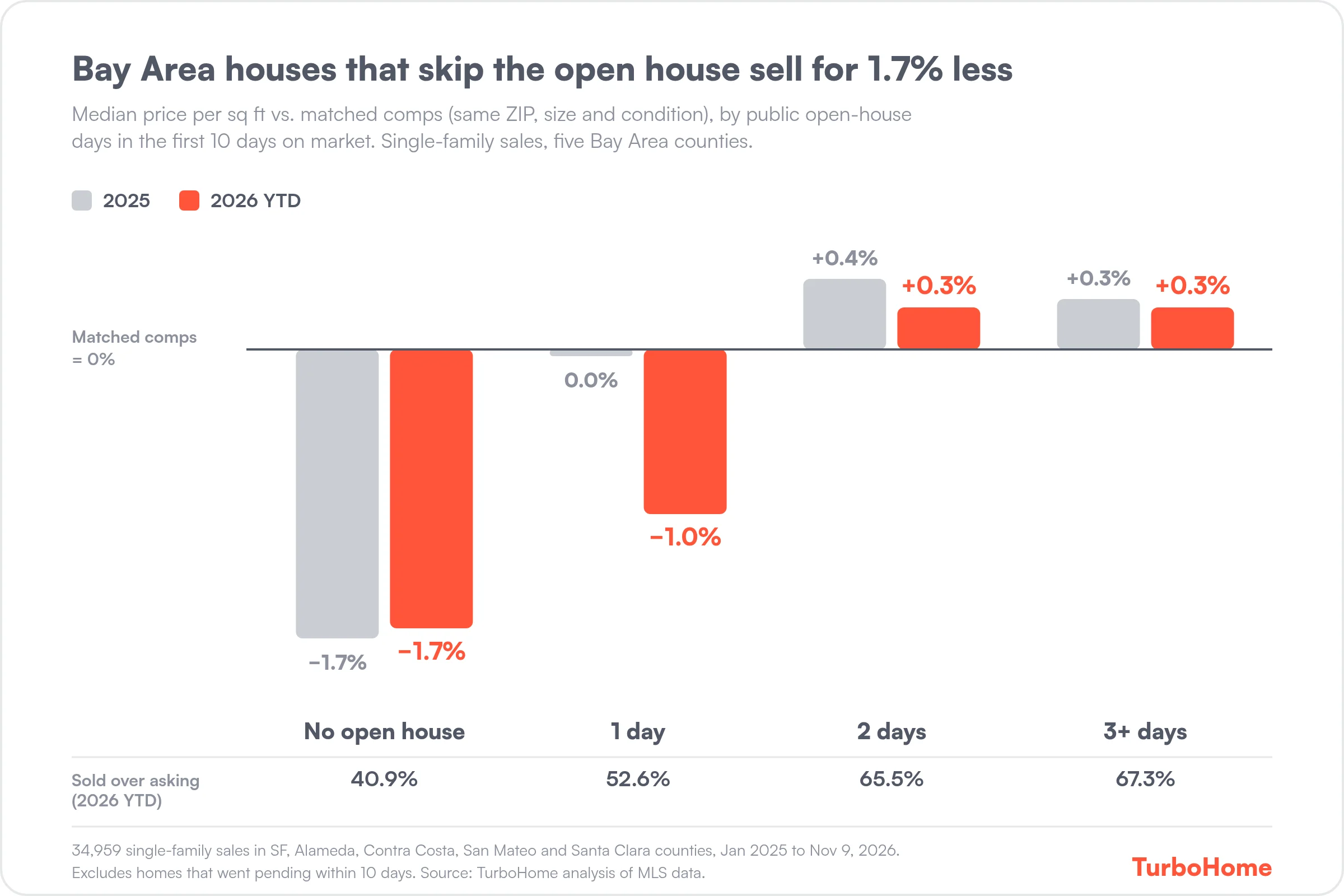
The pattern steps up with each open-house day. With no open house, houses sold 1.7% below comps in both years. With one day, they sold 1.0% below in 2026 and about even in 2025. With two days or more, they sold 0.3% to 0.4% above. Two separate years of sales landed on nearly the same penalty for skipping: −1.72% in 2025 and −1.66% in 2026.
In the table below, open-house days count the first 10 days on market. Price per square foot vs. comps and sale-to-original-list price are medians. Over asking is the share of sales that closed above the original list price.
| Open-house days | Year | Sales | $/sq ft vs. comps | Sale-to-list | Over asking |
|---|---|---|---|---|---|
| No open house | 2025 | 4,206 | −1.72% | 100.0% | 47.3% |
| No open house | 2026 YTD | 2,616 | −1.66% | 100.0% | 40.9% |
| 1 day | 2025 | 2,335 | −0.04% | 100.0% | 47.8% |
| 1 day | 2026 YTD | 1,850 | −0.98% | 100.1% | 52.6% |
| 2 days | 2025 | 6,451 | +0.42% | 102.4% | 63.2% |
| 2 days | 2026 YTD | 5,219 | +0.25% | 103.0% | 65.5% |
| 3+ days | 2025 | 6,281 | +0.30% | 102.2% | 60.7% |
| 3+ days | 2026 YTD | 6,001 | +0.25% | 104.3% | 67.3% |
Why open houses raise sale prices: they assemble competition
The skeptics are right about one thing. An open house is rarely where a buyer discovers a home. In the National Association of Realtors’ 2025 Profile of Home Buyers and Sellers, 52% of buyers found the home they bought online. But 48% used open houses during their search, and 43% rated them very useful. Buyers find the home on their phone, then show up to decide whether to fight for it.
That’s where the price difference comes from. In 2026, 41% of houses with no open house sold over asking, compared with 67% of houses with three or more open-house days. The median sale reached 100.0% of the original list price with no open house and 104.3% with three or more days.
An open house puts several buyers in the same rooms on the same weekend, where they can see each other. That’s what turns a listing into a bidding war. The open house isn’t where the sale happens. It’s where the competition gets assembled.
This fits two earlier findings. Our teaser list price analysis showed that much of a Bay Area overbid is set at listing, when the price and launch plan are chosen, and the open house is part of that launch. Our 15-day cliff analysis found that homes going into contract on day 13 sold for a median 109.3% of original asking, while homes going into contract on day 17 sold for 100.2%. A quiet first weekend spends the most valuable days a listing has.
Where skipping the open house costs the most
The gap is widest where bidding wars are hottest. Here is how homes with no open house compared with homes that held two or more open-house days in 2026, across all property types:
| County | No open house vs. comps | 2+ open-house days vs. comps |
|---|---|---|
| Alameda | −2.8% | +0.6% |
| San Mateo | −2.4% | 0.0% |
| San Francisco | −1.2% | +0.2% |
In Alameda County, the spread is more than 3 points. In Contra Costa and Santa Clara counties, the gap between the two groups was under half a point, so the open house matters far less there.
Condos are a different story. Bay Area condos with no open house sold within 0.1% of comps in 2026, across 956 sales. The open-house effect is a house effect. For local prices and trends, see our housing market guides for San Francisco, Oakland and San Mateo.
What this data does not prove
This is a correlation, not proof that an open house adds 1.7% to any single home. Agents choose which homes get open houses. Tenant-occupied homes, estate and probate sales and homes sold as-is skip them more often, and those homes can sell for less for other reasons. We control for ZIP, size and a condition score, which narrows that bias but doesn’t remove it. Redfin makes the same point about open-house data: homes chosen for open houses tend to be the ones agents already expect to perform well.
A few more limits to keep in mind:
- Open-house records are schedules, not attendance. We counted the open houses agents entered in the MLS. Some may have been cancelled.
- Condition data isn’t complete. The effect held for homes with a known condition score (all property types, 2026: −1.5% with no open house vs. +0.2% with two or more days). It was smaller for homes without one (−0.4% vs. +0.2%).
- Raw sale-to-list numbers overstate the effect. The 100.0% vs. 104.3% difference is larger than the comp-matched gap because open-house homes cluster in high-overbid ZIPs and are more often priced to draw offers. That’s why we lead with the comp-matched figure.
Still, the pattern survived our controls and repeated two years in a row. It also matches an earlier Redfin report on homes listed in 2018, which found that homes with an open house in their first week sold faster and for more relative to list price than homes never held open.
Should you have an open house when selling? What to do with this
If you’re selling a house
- Ask for a written launch plan before you sign. Every agent you interview, whatever they charge, should tell you which days the home will be open to the public, when brokers will tour it and when offers will be reviewed.
- Hold public open houses in the first weekend. In our data, two open-house days did as well as three or more, and both beat one day or none.
- If an agent wants to skip the open house, ask why. Tenants in place can be a good reason. An agent hoping to find the buyer themselves is not. In our dual agency analysis of four Bay Area counties, 36% of homes where one agent represented both sides had no public open house, compared with 18% when each side had its own agent.
- If you sell quietly, do it on purpose. Under NAR’s Multiple Listing Options for Sellers policy, a seller who chooses an office-exclusive or delayed-marketing listing signs a disclosure acknowledging the broad, immediate exposure they’re giving up. Weigh privacy against the price gap above.
- Pick your listing month with care. Our best time to sell analysis shows which months Bay Area listings get cut most.
If you’re buying
A house with no open house is a less crowded house. In our data, those homes sold closer to asking and below comps. If a listing you like has no open house scheduled, ask your agent to request a private showing instead of waiting for a weekend that may never come. With your own agent, a Bay Area buyer rebate can also return part of the commission to you at closing.
If you’re investing
Low-exposure single-family listings are a measurable source of below-comp pricing. Condos are not.
For more Bay Area seller data, see how Bay Area realtor fees work, our Bay Area homebuyer hub and all of our California market updates.
Methodology notes
- Source: TurboHome analysis of MLS closed sales, listing records and scheduled open houses.
- Geography: San Francisco, Alameda, Contra Costa, San Mateo and Santa Clara counties. Marin, Sonoma, Napa and Solano counties are excluded because open-house coverage and sample sizes there are thin.
- Date range: Closings from January 1, 2025 to November 9, 2026. 2026 is a partial year.
- Sample: Single-family residences for the headline figures and condominiums for comparison, with an original list price above $0 and a price per square foot between $100 and $5,000. The chart covers 34,959 single-family sales (15,686 in 2026). The 2026 condo comparison covers 3,148 sales.
- Open house definition: The number of distinct days with a Public or Livestream Public open house 0 to 9 days after the list date. Broker and office tours are not counted. Listings that went pending fewer than 10 days after listing are excluded so a fast sale can’t pass as “no open house.”
- Comp match: Each sale’s price per square foot is divided by the median for sales in the same year, ZIP, property type, within-ZIP size third and condition score (a model-scored rating, with missing scores grouped together). Groups with fewer than 8 sales are dropped. Reported figures are the median of that ratio minus 1.
- Dollar example: The $27,000 figure is illustrative (1.9 points × $1.4 million), not a measured dollar median.
- Caveats: The analysis is observational. Agents choose which homes get open houses, and the controls reduce but don’t remove that selection bias.
- MLS attribution: Data in this report is derived from MLS closed-sale records and is provided for informational purposes only. It has not been independently verified by the Multiple Listing Service and may differ from figures published by MLS associations due to differing cutoff dates, cleaning rules, or geographic groupings.
Sources & further reading
- Door knocks and AI: How smart agents run open houses in 2026 (Inman, November 3, 2026): an agent’s case for treating the open house as marketing rather than the event that sells the home.
- Do Open Houses Sell Homes? (Redfin, September 29, 2026): Redfin’s seller guide, including its note on selection bias in open-house data.
- Redfin Report: Homes With Open Houses in the First Week On Market Sell Faster and For More Money than Those Not Held Open (PR Newswire, April 23, 2019): Redfin’s earlier analysis of 2018 listings.
- Skipping Open Houses for Faster Closings (Florida Realtors, August 12, 2025): why some agents skip open houses.
- Are Open Houses Still Worth It for Real Estate Agents? The 2026 ROI Breakdown (The Close, October 14, 2026): how agents weigh the cost of an open house against the leads it brings in.
- 2025 Profile of Home Buyers and Sellers highlights (National Association of Realtors, November 4, 2025): how buyers find homes and how they use open houses.
- Multiple Listing Options for Sellers (National Association of Realtors, March 2025): the policy on office-exclusive and delayed-marketing listings.
These third-party sources use their own methods and reporting windows and may not match TurboHome’s figures exactly. They are included as context, not as the underlying data for this report.
Frequently asked questions
Do open houses help sell a house?
In the Bay Area, the price data says they do for single-family houses. In TurboHome’s analysis of 34,959 single-family sales in San Francisco, Alameda, Contra Costa, San Mateo and Santa Clara counties from January 2025 to November 9, 2026, houses with no public open house in their first 10 days on market sold a median 1.7% below comparable homes in the same ZIP, size range and condition. Houses with two or more open-house days sold 0.3% to 0.4% above them. This is a correlation, since agents choose which homes get open houses.
Should I have an open house when selling my house in the Bay Area?
If you’re selling a single-family house, the data favors holding public open houses in the first weekend on market. Across all property types in 2026, homes that skipped one sold 2.8% below comps in Alameda County and 2.4% below in San Mateo County, while homes with two or more open-house days sold at or above comps. The gap was under half a point in Contra Costa and Santa Clara counties, and condos showed no meaningful gap.
Can you sell a house without an open house?
Yes. About 1 in 6 Bay Area single-family houses (16.7% of qualifying 2026 sales) had no public open house in their first 10 days. Those homes sold at a median 100.0% of their original list price, compared with 104.3% for houses with three or more open-house days, and 41% sold over asking, compared with 67%.
How much does skipping an open house cost a Bay Area seller?
On a $1.4 million house, the gap of about 1.9 points between no open house and two or more open-house days works out to roughly $27,000. That figure is an illustration based on median gaps against comparable sales, not a measured dollar amount for any one home.
Do condos need an open house to sell for top dollar?
Not in TurboHome’s 2026 data. Bay Area condos with no public open house in their first 10 days sold within 0.1% of comparable condos, based on 956 sales. The open-house gap shows up in single-family houses, not condos.
Keep more of your sale, and the launch that earns it
Saving on commission only matters if you don’t give it back on price. TurboHome lists your home for a flat fee with full-service, licensed agents and MLS data like this behind every pricing call. Ask us for a written launch plan, and hold every agent you interview to the same standard.
About the Author
Lucas Beard
Lucas Beard is COO of TurboHome and holds California DRE license 02417843. His guides reflect TurboHome's buyer-side experience and link to primary sources for regulatory, lender, market, and competitor claims.
View Lucas on LinkedInAbout Kevin Kretzmer
Head Agent, California
Kevin Kretzmer leads TurboHome's California agent team and reviews California and national buyer guidance for practical brokerage accuracy.
View Kevin's profile