Bay Area Market Analysis
“Just Call the Listing Agent” Is Bad Advice for Bay Area Buyers. Here’s the Data.

By Lucas Beard
COO, TurboHome · Last updated November 9, 2026
Reviewed by:

Head Agent, California · CalDRE #01997822
Lose a few Bay Area bidding wars and you’ll hear the same tip from friends and online forums: skip your own agent and call the listing agent. They get both sides of the commission, so they’ll favor your offer. Some buyers do land a home that way. The better question is who that system works for, so we looked at how Bay Area homes sold since 2023.
TurboHome Market Analysis · Bay Area · Published November 9, 2026
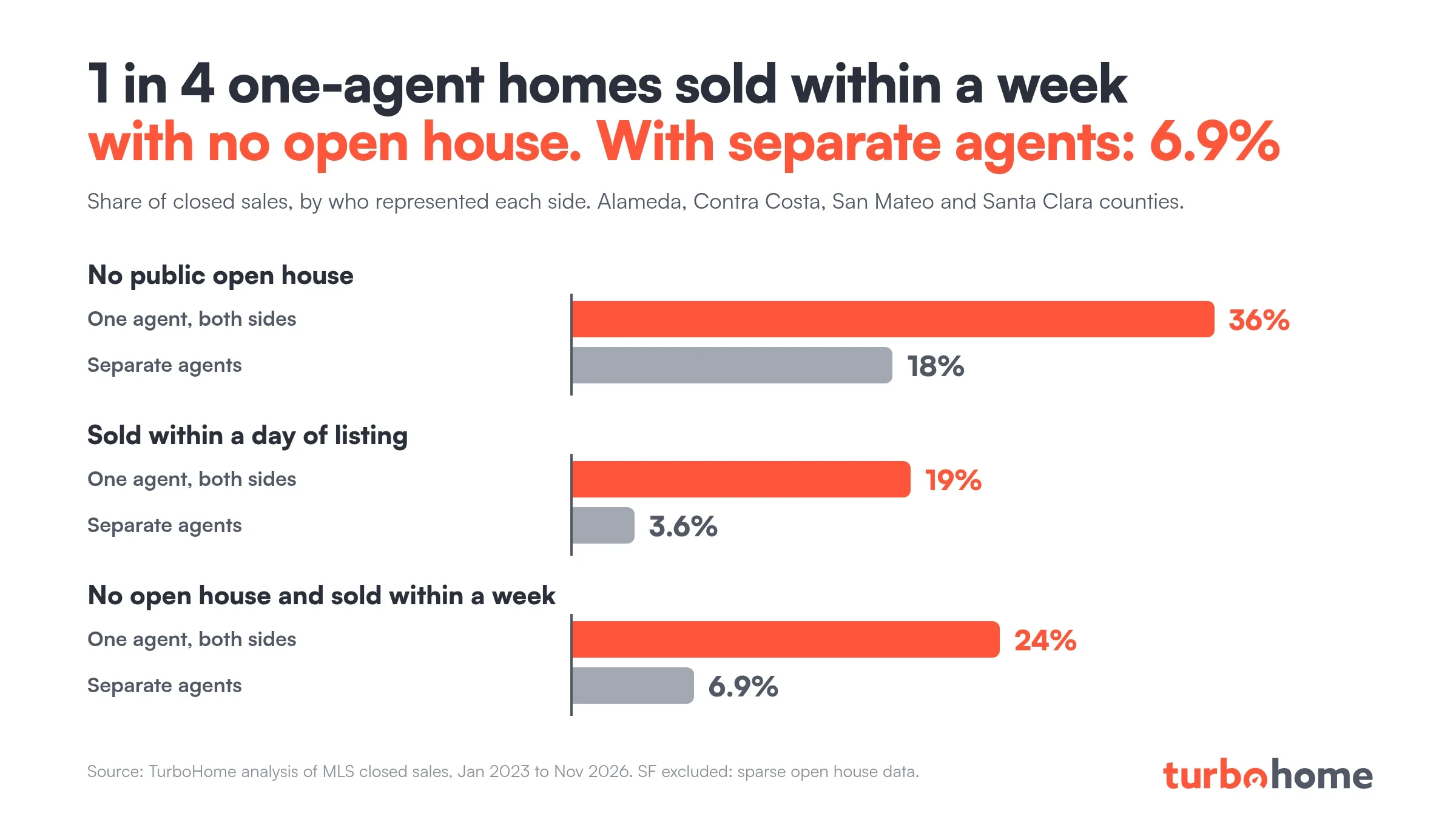
The short answer: dual agency works for the agent, not for buyers. The agent is paid to close the deal in-house, the home is far more likely to sell before most buyers see it, and the buyer inside the deal is told less. In four Bay Area counties, 24% of one-agent sales had no public open house and sold within a week, compared with 6.9% when each side had its own agent. Get your own agent before you tour.
What dual agency means in California
Dual agency is when one real estate broker represents both the buyer and the seller in the same sale. California allows it, but every agency relationship must be disclosed in writing and agreed to by both sides (Civil Code 2079.17).
The legal definition covers two setups (Civil Code 2079.13):
- One agent, both sides. The same person lists the home and represents the buyer. In the industry this is called double-ending a deal. It’s what you get when you call the listing agent and ask them to represent you.
- Two agents, same brokerage. The buyer and seller each have their own agent, but both work at the same firm. California still calls this dual agency, because the broker represents both sides.
The problems below are sharpest in the first case, when one person holds both sides of the deal.
The incentive problem: paid to close, not to push
A listing agent is hired by the seller. When they also bring the buyer, they can collect both sides of the commission. That changes what a good outcome looks like for them.
Zillow Research described the math plainly: “The additional commission earned from pushing a seller’s price up is generally modest, while the potential cost of selling to a different buyer and splitting a commission with another agent is significant” (Zillow Research). The agent’s best result is that their own buyer gets the home. That isn’t the same as the best terms for you, or the best price for the seller.
California’s Department of Real Estate has said the same thing about the role itself: “Since the dual agent cannot focus both on negotiating for the lowest price and negotiating for the highest price, it is easy to see how dual agency creates a conflict” (DRE Real Estate Bulletin, Winter 2019).
The conflict doesn’t end when your offer is accepted. Someone has to tell you whether the inspection report justifies a repair credit, whether a disclosure is a red flag, or whether to walk away. With one agent, that person also owes duties to the seller on every one of those questions, and gets paid only if the deal closes.
The open house problem: homes sell before most buyers can compete
That incentive shows up in how homes come to market. We compared one-agent sales with sales where each side had its own agent in Alameda, Contra Costa, San Mateo and Santa Clara counties, from January 2023 to November 2026. San Francisco is left out because its open house records are sparse before 2025.
When one agent represented both the buyer and the seller:
- 36% of homes had no public open house, compared with 18% when buyer and seller had separate agents.
- 19% sold within a day of listing, compared with 3.6%.
- 24% had no open house and sold within a week, compared with 6.9%.
A one-agent home was more than three times as likely to sell within a week without ever holding an open house. Roughly 1 in 4 did.
A home that sells that fast never gets a weekend of tours or an offer date. Our 15-day cliff analysis found that the first two weeks on market are when the most buyers are looking. If you weren’t already talking to the listing agent, you likely heard about these homes after they were gone.
The industry is fighting over this right now. In March 2025, the National Association of Realtors adopted a policy that lets sellers choose an office-exclusive or delayed-marketing listing, sometimes called a pocket listing (NAR). Zillow responded with rules that keep privately marketed listings off its site, and in February a federal judge denied Compass’s request to block them (NAR). However the rules settle, a home shown privately first gives the listing agent more time to find a buyer of their own.
The transparency problem: you’re told less
Even if you’re the buyer who gets the home, dual agency limits what you can learn.
- The agent can’t share the seller’s position. Without written consent, a dual agent can’t tell you the seller would take less than the list price, or tell the seller you’d pay more than your offer (Civil Code 2079.21). The DRE says this “in effect prevents the broker, when acting as a dual agent, from negotiating the price and related financial terms on behalf of either the seller or buyer or both” (DRE Reference Book).
- No one is advising you. Calling the listing agent doesn’t always make them your agent. A listing agent can sell to a buyer who has no agent, but the DRE notes they then may not advise or counsel that buyer.
- You can’t see who else was told. When a home is marketed quietly, only the listing agent knows which buyers heard about it and which offers came in. You’re trusting the person who benefits most from your offer winning.
California requires agency relationships to be disclosed and confirmed in writing. Read that disclosure before you sign anything, and ask who the agent works for.
What Bay Area buyers should do
- Get your own agent before you tour. Then someone works only for you from the first showing, including when you find a home through its listing agent.
- Ask the listing agent about timing. Will the home go to an offer date, or is the seller reviewing offers as they come in? The answer tells you how fast you need to move.
- Watch new and coming-soon listings. Set alerts for new MLS listings, and ask your agent to track coming-soon and office-exclusive listings in the areas you want.
- Treat “I can represent you too” as a red flag. It sounds like a shortcut. It means no one at the table works only for you.
Your own agent doesn’t have to cost you the savings, either. TurboHome’s Bay Area buyer rebate credits buyers part of the commission, and our Bay Area realtor fee guide explains how commissions work now. For local prices, start with the Bay Area market hub.
Methodology notes
- Source: TurboHome analysis of MLS closed sales.
- Geography: Alameda, Contra Costa, San Mateo and Santa Clara counties. San Francisco is excluded because its open house records are sparse before 2025.
- Date range: Closings from January 2023 to November 2026.
- Property types: Single-family homes, condos and townhouses.
- Groups compared: Sales where one agent represented both buyer and seller, and sales where the buyer’s and seller’s agents came from separate brokerages.
- Caveats: These figures show a pattern, not causal proof. Homes sold by one agent may differ in ways the data can’t see, such as how urgently the seller needed to sell. Sales never recorded in the MLS are not included.
- MLS attribution: Data in this report is derived from MLS closed-sale records and is provided for informational purposes only. It has not been independently verified by the Multiple Listing Service and may differ from figures published by MLS associations due to differing cutoff dates, cleaning rules, or geographic groupings.
Sources & further reading
- Selling With Same Agent On Both Sides Cost Home Sellers $1.49 Billion Over Three Years (Zillow Research, May 2026)
- California Civil Code 2079.13, agency definitions
- California Civil Code 2079.21, dual agent confidentiality
- Reference Book, Chapter 10: Agency (California Department of Real Estate)
- Real Estate Bulletin, Winter 2019 (California Department of Real Estate)
- Multiple Listing Options for Sellers (National Association of Realtors)
- Judge Rejects Compass’s Request to Block Zillow’s Private Listing Rule (NAR, February 2026)
Frequently asked questions
Should I use the listing agent to buy a house?
Usually not. The listing agent’s first duty is to the seller. If they also represent you, California law bars them from telling you the seller would take less than the list price without written consent, and the Department of Real Estate says a dual agent in effect can’t negotiate price for either side. In TurboHome’s Bay Area data, homes with one agent on both sides were more than three times as likely to sell within a week with no open house, so fewer buyers got to compete for them.
Why do listing agents want to represent the buyer too?
Because selling to their own buyer pays more than splitting the commission with another agent. Zillow Research put it this way: the extra commission from pushing a seller’s price up is generally modest, while the cost of selling to a different buyer and splitting the commission is significant. That rewards closing the deal in-house, not finding you the best terms.
How do I find off-market homes in the Bay Area?
Start with your own agent. Ask them to track new MLS listings, coming-soon listings and office-exclusive listings in the areas you want, and to ask listing agents early whether a home will go to an offer date. Be wary of any shortcut that makes the seller’s agent your agent too.
Is dual agency legal in California?
Yes. California allows one broker to represent both the buyer and the seller if both agree in writing. Under Civil Code 2079.13, that includes two agents who work for the same brokerage, because the broker is the agent for both sides. A dual agent may not tell the buyer the seller will take less than the list price, or tell the seller the buyer will pay more than the offer, without written consent (Civil Code 2079.21).
Get your own agent before you tour
The listing agent works for the seller. TurboHome buyer agents work only for you, and our Bay Area buyer rebate credits you part of the commission. Talk to an agent before you call the listing agent.
About the Author
Lucas Beard
Lucas Beard is COO of TurboHome and holds California DRE license 02417843. His guides reflect TurboHome's buyer-side experience and link to primary sources for regulatory, lender, market, and competitor claims.
View Lucas on LinkedInAbout Kevin Kretzmer
Head Agent, California
Kevin Kretzmer leads TurboHome's California agent team and reviews California and national buyer guidance for practical brokerage accuracy.
View Kevin's profile