Bay Area Market Analysis
Bay Area HOA Fees Went From a Price Premium to a Penalty, but Buyers Still Pay Most of the Cost

Reviewed by:

Head Agent, California · CalDRE #01997822
Picture two condos of the same size in the same Bay Area ZIP code, with HOA dues $400 a month apart. In 2026, the one with higher dues sells for about $25,000 less. That looks like a fair trade until you run the mortgage math: at today’s 7.18% rate, $400 a month would carry about $59,000 of loan. The buyer of the high-dues condo makes up the difference every month.
TurboHome Market Analysis · Bay Area · Published November 6, 2026
In 2019, each extra $100 a month of HOA dues came with about $4,870 more in a Bay Area condo’s sale price. In 2026, it comes with about $6,200 less. That discount covers only 42% of the $14,762 of mortgage the same $100 a month could carry, so high-dues buyers still pay most of the cost.
The flip in one chart
We compared condo sales in San Francisco, Alameda, Contra Costa, San Mateo and Santa Clara counties from January 2019 through November 5, 2026 with other sales in the same ZIP and year, adjusting for size. Then we measured how sale prices moved as monthly dues went up.
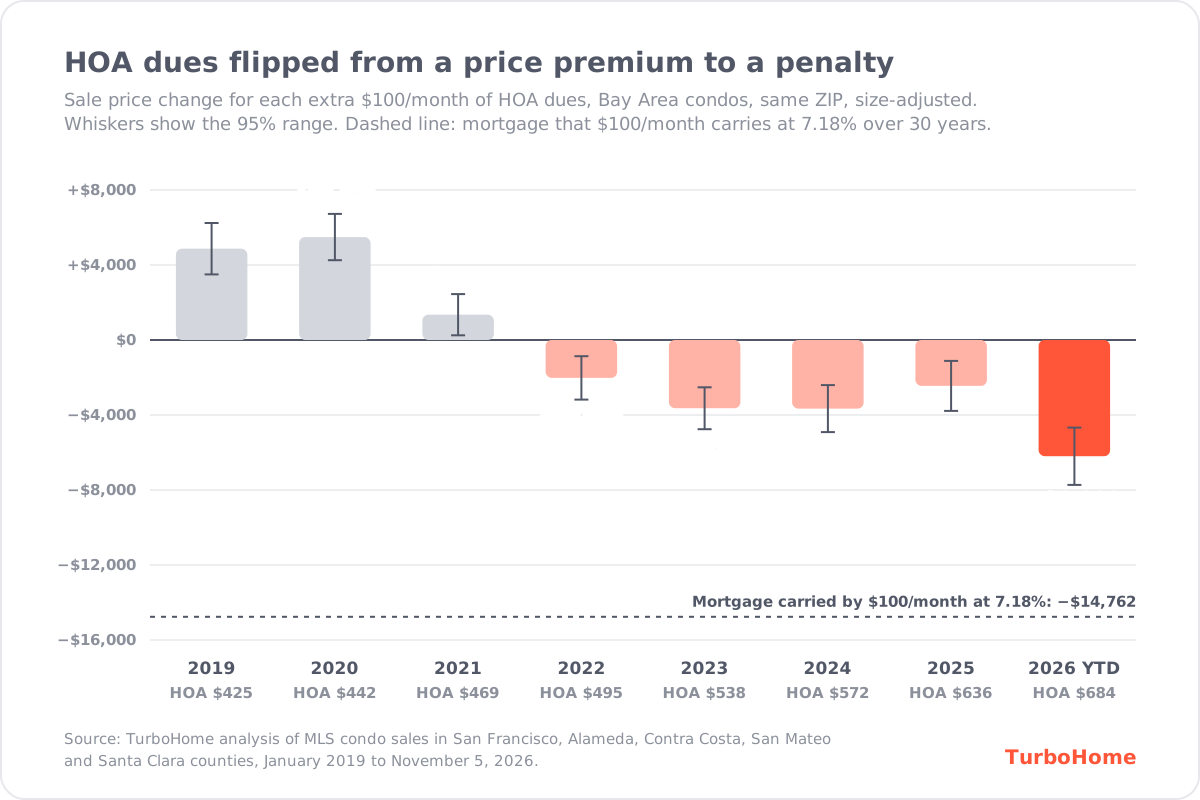
High dues carried a price premium through 2021. In 2022 the sign flipped, and the penalty has held every year since. The 2026 reading is the steepest in eight years of data, based on 4,857 condo sales so far this year. Even so, it sits less than halfway to the dashed line, which marks what $100 a month is worth in borrowing power.
| Year | Price change per $100/mo of HOA | 95% range | Median monthly HOA | Condo sales |
|---|---|---|---|---|
| 2019 | +$4,870 | +$3,498 to +$6,242 | $425 | 4,109 |
| 2020 | +$5,490 | +$4,255 to +$6,725 | $442 | 7,801 |
| 2021 | +$1,350 | +$252 to +$2,448 | $469 | 11,781 |
| 2022 | −$2,020 | −$3,176 to −$864 | $495 | 9,051 |
| 2023 | −$3,640 | −$4,757 to −$2,523 | $538 | 6,198 |
| 2024 | −$3,660 | −$4,914 to −$2,406 | $572 | 6,550 |
| 2025 | −$2,450 | −$3,783 to −$1,117 | $636 | 5,694 |
| 2026 YTD | −$6,200 | −$7,729 to −$4,671 | $684 | 4,857 |
Why high HOA dues used to raise prices
Before 2022, higher dues were a selling point more often than a warning sign. Two things made that work.
- Dues signaled a full-service building. High dues usually meant door staff, a concierge, a gym, a pool, elevators and well-funded upkeep. Buyers paid more per square foot for those perks.
- Cheap money kept the payment manageable. With mortgage rates around 4%, an extra $100 to $200 a month barely changed how much a bank would lend.
Why they lower prices now
The perks are the same. The math around them changed.
- Higher rates shrink borrowing power. At 7.18%, Freddie Mac’s 30-year average for the week of November 5, 2026, every $100 a month of dues uses up about $14,800 of mortgage capacity. Lenders count HOA dues in your debt-to-income ratio, so higher dues mean a smaller loan approval.
- Dues keep climbing. The median monthly HOA on sold condos in our sample rose 61%, from $425 in 2019 to $684 in 2026. Realtor.com sees the same trend across the metro: the median monthly HOA fee in the San Francisco metro area reached $502 in 2025, up from $360 in 2019, and the share of homes with HOA dues rose from about 40% to over 47%, as reported by Axios.
- Buyers shop by the monthly payment. With prices and rates both high, buyers compare mortgage plus HOA plus property taxes rather than list price. Heavy dues start to feel like a second mortgage, so sellers cut price to reach qualified buyers.
The gap buyers still pay
A common belief is that high HOA dues are “already priced in.” The data says that is only partly true.
At 7.18%, $100 a month of dues takes up about $14,762 of mortgage. The market discounts about $6,200 of that, or 42%. The other 58%, roughly $8,560 of borrowing power for every $100 of monthly dues, shows up on the buyer’s monthly bill for as long as they own the unit.
To be fair to HOAs, dues pay for real things, such as building insurance, water and staff, that an owner would otherwise pay for some other way. A discount smaller than the full financing cost is expected, and part of the gap is value rather than overpaying. The job for a buyer is to work out how much of it is value in the specific building they’re considering.
Where the penalty bites hardest
The 2026 penalty varies widely by county.
| County | Price change per $100/mo of HOA, 2026 |
|---|---|
| San Francisco | −$9,160 |
| Santa Clara | −$8,210 |
| Contra Costa | −$4,910 |
| Alameda | No measurable penalty |
San Francisco and Santa Clara County buyers discount high dues most heavily. In Alameda County, dues showed no measurable effect on price in 2026, which means buyers there absorb nearly all of the cost of higher dues. For typical dues by city, see our guides to HOA fees in San Francisco, San Jose and Oakland.
What to do with this
If you’re buying a condo
- Compare total monthly cost, not list price. Add the mortgage payment, HOA dues, property taxes and insurance for each unit you’re considering. Our income needed to buy in San Francisco guide shows how those costs add up.
- Turn the dues gap into loan dollars. Each $100 a month of dues is about $14,800 of borrowing at 7.18%. Compare that with how much lower the high-dues unit is priced, then credit what the dues actually cover.
- Ask for the reserve study and dues history. A thin reserve or a history of steep increases points to higher dues ahead.
- Ask about special assessments. Dues shown on a listing may not include them.
If you’re selling in a high-dues building
Price against what competing units cost buyers each month, not just price per square foot. Spell out what the dues cover, such as insurance, water or staff, so buyers can credit those costs.
If you’re investing
Dues come straight out of rental yield, so run the numbers on net rent after HOA.
For more on the condo market, see our San Francisco condo vs house analysis, our Bay Area homebuyer hub and all of our California market updates.
Methodology notes
- Source: TurboHome analysis of MLS closed condo sales.
- Geography: San Francisco, Alameda, Contra Costa, San Mateo and Santa Clara counties. Marin and the rest of the North Bay had too few condo sales per ZIP to meet the benchmark below.
- Date range: Closings from January 1, 2019 to November 5, 2026. 2026 is a partial year.
- Sample: Condominiums only (townhouses and TICs excluded), 300 to 4,000 square feet, $150 to $3,000 per square foot, with listing-reported monthly HOA dues of $1 to $5,000. Sales with zero or missing dues are excluded. Sales counts by year appear in the table above.
- Method: Each sale is compared with the median price per square foot in its ZIP for the same calendar year, and ZIP-years with fewer than 15 qualifying sales are dropped. Within each ZIP-year, the difference in price per square foot is measured against the difference in HOA dues per square foot. The result is shown as dollars of sale price per $100 of monthly dues. The 95% range is the estimate plus or minus 1.96 standard errors.
- Mortgage equivalent: The present value of $100 a month over 360 months at 7.18%, Freddie Mac’s 30-year average for November 5, 2026, is $14,762.
- Caveats: Dues are a weak predictor of any single sale (a correlation of about −0.11 in 2026), so the figures are averages. Listing-reported dues may exclude special assessments. The analysis controls for ZIP and size but not for floor, view, parking or building age.
- MLS attribution: Data in this report is derived from MLS closed-sale records and is provided for informational purposes only. It has not been independently verified by the Multiple Listing Service and may differ from figures published by MLS associations due to differing cutoff dates, cleaning rules, or geographic groupings.
Sources & further reading
- Mortgage Rates Decline for Third Consecutive Week to 7.18% (Freddie Mac via GlobeNewswire, November 5, 2026): the 30-year fixed-rate average used for the mortgage equivalent.
- HOA fees top $500 in Bay Area surge (Axios San Francisco, March 19, 2026): Realtor.com data on median HOA fees and the share of homes with HOA dues in the San Francisco metro area.
These third-party sources use their own methods and reporting windows and may not match TurboHome’s figures exactly. They are included as context, not as the underlying data for this report.
Frequently asked questions
How much do HOA fees affect condo prices in the Bay Area?
In TurboHome’s analysis of condo sales in San Francisco, Alameda, Contra Costa, San Mateo and Santa Clara counties, each extra $100 a month of HOA dues came with about $6,200 less in sale price in 2026 (January 1 to November 5), compared with same-size condos in the same ZIP. In 2019 the same $100 a month came with about $4,870 more in price.
Are high HOA fees already priced into Bay Area condos?
Only partly. At the 7.18% 30-year mortgage rate Freddie Mac reported on November 5, 2026, $100 a month carries about $14,762 of mortgage. The 2026 price discount of about $6,200 covers 42% of that, so buyers in high-dues buildings pay the rest month by month. Dues also pay for real services such as building insurance, water and staff, so part of that gap is value rather than overpaying.
How do HOA fees affect mortgage qualification?
Lenders count HOA dues in your debt-to-income ratio, the same way they count the mortgage payment. At a 7.18% 30-year rate, every $100 a month of dues uses up about $14,800 of the loan amount you could otherwise qualify for.
Where in the Bay Area do high HOA dues lower condo prices the most?
In 2026, San Francisco showed the largest penalty, about $9,160 less in sale price per extra $100 a month of dues, followed by Santa Clara County at about $8,210 and Contra Costa County at about $4,910. Alameda County showed no measurable penalty.
Get the total monthly cost on every condo you tour
A list price only tells you half the story on a condo. TurboHome agents compare units on what you’ll pay each month, dues included, and pull same-ZIP comps before every offer. Our flat-fee model also returns a buyer rebate at closing, so more of the commission stays with you.
About the Author
Lucas Beard
Lucas Beard is COO of TurboHome and holds California DRE license 02417843. His guides reflect TurboHome's buyer-side experience and link to primary sources for regulatory, lender, market, and competitor claims.
View Lucas on LinkedInAbout Kevin Kretzmer
Head Agent, California
Kevin Kretzmer leads TurboHome's California agent team and reviews California and national buyer guidance for practical brokerage accuracy.
View Kevin's profile