How Much Does a Buyer's Agent Cost in 2026?

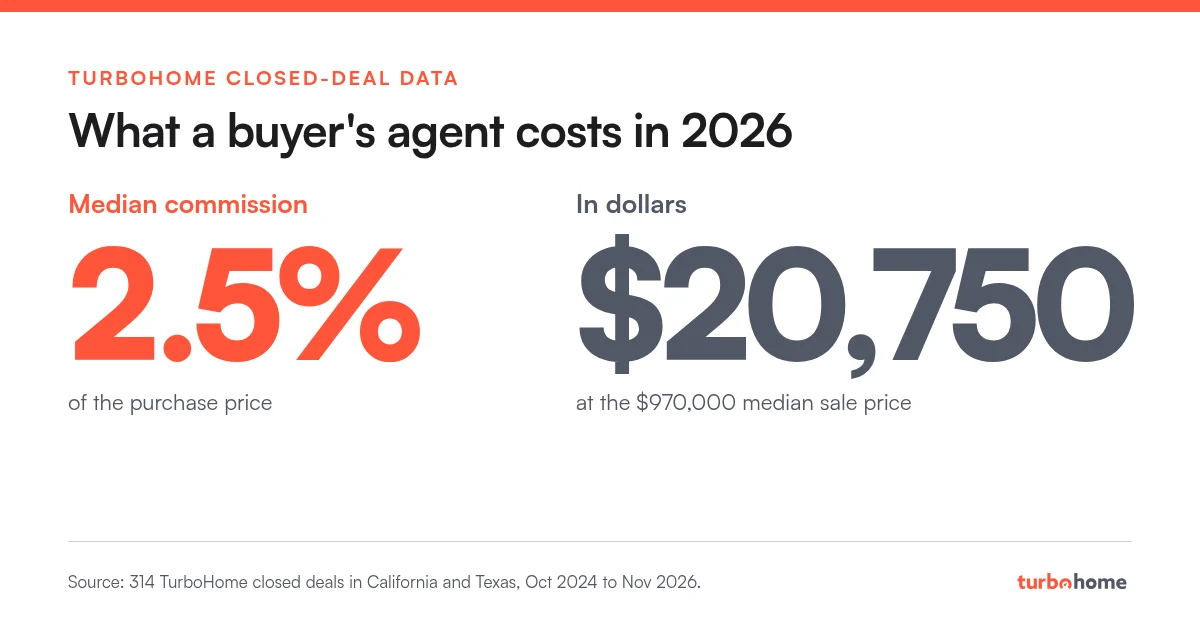
In 2026, a buyer's agent typically costs around 2.5% of the home's purchase price—which worked out to $20,750 on a typical home in our data. Across 314 closed TurboHome transactions in California and Texas between October 2024 and November 2026, the median buyer-agent commission requested from the seller was 2.5%, while the average was 2.23%. At the median sale price of $970,000, that commission came to $20,750. Overall, 215 of those 314 deals (68%) carried a commission of 2.5% or higher, while 59 deals (19%) came in under 2%.
Those numbers are a starting point, not a fixed rule. Buyer-agent commissions are negotiable, and the dollar cost changes dramatically depending on how much house you buy. Below is a breakdown of what buyers and sellers actually saw across different price bands, states, and years—and what it means for your budget if you are shopping for a home.
Buyer's agent costs by home price range
Percentage rates are easy to gloss over until you see them in dollars. To show how commissions scale, we grouped the 314 closed deals into five price bands. In the table below, the median is simply the middle number in each group, which keeps a handful of unusually high or low deals from skewing the picture.
| Sale price | Deals | Median price | Median % | Average % | Median commission ($) | Share at 2.5%+ | Share under 2% |
|---|---|---|---|---|---|---|---|
| Under $500k | 42 | $388,950 | 2.5% | 2.69% | $9,620 | 90% (38) | 5% (2) |
| $500k–$1M | 118 | $800,000 | 2.5% | 2.19% | $17,713 | 63% (74) | 21% (25) |
| $1M–$1.5M | 72 | $1,200,000 | 2.5% | 2.18% | $28,704 | 68% (49) | 18% (13) |
| $1.5M–$2M | 49 | $1,703,000 | 2.5% | 2.13% | $39,813 | 71% (35) | 22% (11) |
| $2M+ | 33 | $2,385,000 | 2.5% | 2.02% | $56,500 | 58% (19) | 24% (8) |
| All | 314 | $970,000 | 2.5% | 2.23% | $20,750 | 68% (215) | 19% (59) |
Two patterns jump out from this table:
- The typical rate is 2.5% everywhere, but the average dips as prices climb. At every single price level, the median commission was 2.5%. Still, the average percentage drifted lower on pricier homes—from 2.69% on homes under $500,000 down to 2.02% on homes at $2 million and above. Similarly, commissions under 2% were rare below $500,000 (just 5% of deals) and much more common at $2 million and up (24% of deals).
- Even with slightly lower percentages, the dollar bill climbs steeply. On a typical home under $500,000 (median price $388,950), the median commission was $9,620. Move up to the $500,000–$1 million tier (median price $800,000), and it jumps to $17,713. By the $1 million–$1.5 million range, it reaches $28,704. In the $1.5 million–$2 million bracket, it hits $39,813, and above $2 million, the median commission was $56,500.
How commissions varied by state and year
Real estate norms are local, and our numbers reflect a clear gap between California and Texas—though our Texas data is a much smaller sample.
| State | Deals | Median % | Average % | Share at 2.5%+ |
|---|---|---|---|---|
| California | 279 | 2.5% | 2.16% | 66% (184) |
| Texas | 35 | 3% | 2.79% | 89% (31) |
In California, which accounts for 279 of our 314 deals, the median rate was 2.5% and the average was 2.16%, with 66% of transactions at 2.5% or higher. In Texas, the median was 3% and the average was 2.79%, with 89% of deals at 2.5% or more. Because we only had 35 closed deals in Texas in this dataset, treat the Texas figures as an early snapshot rather than the final word on the state.
We also checked whether rates shifted between 2025 and 2026:
| Year (close date) | Deals | Median % | Average % |
|---|---|---|---|
| 2024 (Oct–Dec only) | 7 | 1.25% | 1.21% |
| 2025 | 85 | 2.5% | 2.15% |
| 2026 (through Nov 20) | 222 | 2.5% | 2.29% |
Between 2025 (85 deals) and 2026 through November 20 (222 deals), the typical commission barely budged: the median stayed at 2.5% in both years, while the average was 2.15% in 2025 and 2.29% in 2026. The late-2024 slice includes only 7 deals, which is far too small to draw any trend from.
Who pays the buyer's agent—and how negotiation works now
If you bought a house years ago, you may remember hearing that the seller simply paid both agents and the buyer did not have to think about it. The rules changed in August 2024, and buyers now see agent compensation up front.
First, buyer-agent pay is no longer advertised through the MLS (the Multiple Listing Service, the shared database agents use to list homes for sale). Second, before touring homes with an agent, buyers sign a written buyer representation agreement—a contract that spells out what the agent will do and exactly how much they will be paid.
Crucially, that fee is negotiable. You do not have to accept the first percentage an agent suggests, and even small changes in the rate add up fast:
- On an $800,000 home, a 2% commission is $16,000, a 2.5% commission is $20,000, and a 3% commission is $24,000.
- On a $1,000,000 home, every 0.5 percentage point equals $5,000.
Just as important is who pays the bill. Even though you agree on your agent's fee up front, you can still ask the seller to cover it as part of your purchase offer. Depending on what you and the seller negotiate, the buyer's agent can be paid by the seller, by the buyer directly, or split between both sides. In our dataset, the numbers above reflect what the buyer's side asked the seller to pay.
Why percentage fees climb—and how a flat-fee agent is different
With a traditional percentage commission, your agent's fee is tied directly to the purchase price of the home. That creates an awkward disconnect for buyers: the dollar cost grows automatically as home prices rise, even when the work involved in touring homes, writing an offer, negotiating repairs, and closing the deal does not grow at the same rate.
You can see that gap plainly in our price-band table. The median commission was $9,620 on homes under $500,000, $28,704 on homes between $1 million and $1.5 million, and $56,500 on homes over $2 million—roughly six times as much, even though the steps of a purchase are largely the same.
A flat-fee agent takes a different approach. Instead of charging a percentage of the sale price, a flat-fee agent charges a set dollar fee that stays the same regardless of whether the house costs $500,000 or $2 million. Because the fee is decoupled from the purchase price, it keeps your agent cost from scaling upward just because you are shopping in a more expensive neighborhood or price bracket.
A few caveats about this data
Before using these numbers to plan your purchase, keep three limitations in mind:
- This is TurboHome's data, not the whole U.S. market. All 314 deals are TurboHome's own closed transactions between October 2024 and November 2026 (for homes priced between $50,000 and $50 million), and 279 of them were in California. Markets in other states may look different.
- It measures seller-requested commissions only. The figures show the commission the buyer's side asked the seller to pay. Our dataset does not include a separate field for any portion a buyer may have paid out of pocket.
- Some deals were excluded. We left out 137 closed deals that had 0% recorded in the seller-commission field. Those records also had no dollar amount, so we cannot tell whether the seller paid nothing or the field was simply left blank.
Practical takeaways for buyers
If you are planning to buy a home in 2026, a little preparation before you tour your first house can save you from surprises at the closing table:
- Do the math in dollars, not just percentages. Before you sign a buyer representation agreement, multiply the proposed rate by your target budget so you know the real dollar figure on the table.
- Treat the rate as negotiable. Nearly one in five deals in our data (19%) came in under 2%, and rates above $500,000 showed noticeably more flexibility than lower price tiers. Ask agents how they set their fee and what services are included.
- Clarify who will pay your agent in your offer. Ask your agent early on how they handle requesting commission from the seller—and what happens if a seller offers less than the amount in your agreement.
- Compare percentage agents with flat-fee options. Especially if you are shopping in higher price brackets, compare what a traditional percentage costs against a flat-fee structure so you are paying for the work rather than the price tag of the house.
If you want full buyer representation without a fee that climbs alongside your home's price, see how TurboHome's flat-fee agents work before you start touring homes.

Ready to buy and keep the commission?
Talk to a local agent in California or Texas about your search and your TurboHome rebate.
Licensed local Realtors. Free private tours. No obligation.